
2026 BYD Atto 2 DM-i Premium Review
The 2026 BYD Atto 2 DM-i Premium pairs a $29,990 price with 90km of electric range, a polished cabin and surprisingly good manners. Is it the one to buy?

The Premium delivers exceptional value through its comfortable cabin, useful electric range and polished driving experience. Slow charging, an unproven crash-safety rating and fairly expensive servicing stop it being an unqualified recommendation.
Read why ↓$29,990
156 kW
300 Nm
0.7L/100km claimed combined; approximately 5.7L/100km observed in charge-hold hybrid driving
Unrated
2026
- Excellent cabin quality and comfort for the money
- Premium's 90km claimed electric range and strong performance
- Composed handling and smooth, EV-first power delivery
- Slow 3.3kW AC charging with no DC capability
- No ANCAP rating yet
- Five-year servicing costs more than key hybrid rivals
Intro
A plug-in hybrid SUV for $24,990 before on-road costs sounds like an invitation to start looking for the catch. The 2026 BYD Atto 2 DM-i is Australia's cheapest PHEV, and even this range-topping Premium slips in under $30,000 before on-roads.
The surprise isn't just that it works. It's how little of the driving experience or cabin quality feels dictated by that price. This is a comfortable, practical small SUV with proper electric running capability and a petrol engine for the trips that stretch beyond it.
Expectations were fairly low after our experience with the smaller Atto 1. The Atto 2 DM-i Premium overturns them convincingly, although its slow charging and the Essential's much smaller battery deserve attention before anyone signs an order.
How much does the BYD Atto 2 DM-i cost?
Finance or novated lease this BYD Atto 2 DM-i
Get a free, no-obligation quote from our finance partner, Loan Options — for straightforward car finance, or package this car through your salary with a novated lease.
The entry price does the advertising, but the Premium makes the stronger buying argument. Its extra $5000 buys considerably more electric range and performance, not just nicer upholstery.
2026 BYD Atto 2 DM-i Pricing
Non-white paint adds $600, with the Turquoise finish on the test car exclusive to the Premium. An Essential launch offer brings the entry model to $25,990 drive-away for orders placed before 24 December 2026.
The Premium replaces the Essential's 7.85kWh battery with an 18.03kWh pack, lifting claimed electric range from 39km to 90km. System power also increases from 122kW to 156kW, alongside heated synthetic leather seats, a bigger screen, better audio and a panoramic roof. We'd spend the extra if the budget allows.
Against the 2026 Chery Tiggo 4 Hybrid Urban and MG ZS Hybrid+ Excite, both priced at $29,990 drive-away, remember that the BYD Premium's matching headline number excludes on-road costs. Those regular hybrids don't need plugging in, but neither offers the BYD's extended electric-only running. Even the next-cheapest PHEV, BYD's own Sealion 5, starts higher at $33,990 before on-roads.
- BYD Atto 2 DM-i Essential $24,990 before on-road costs
- BYD Atto 2 DM-i Premium $29,990 before on-road costs
Got a car to sell or trade in?
Get competing offers from dealers with CarSauce Sell. Free, no obligation.
Get my offersCheap doesn't have to look apologetic
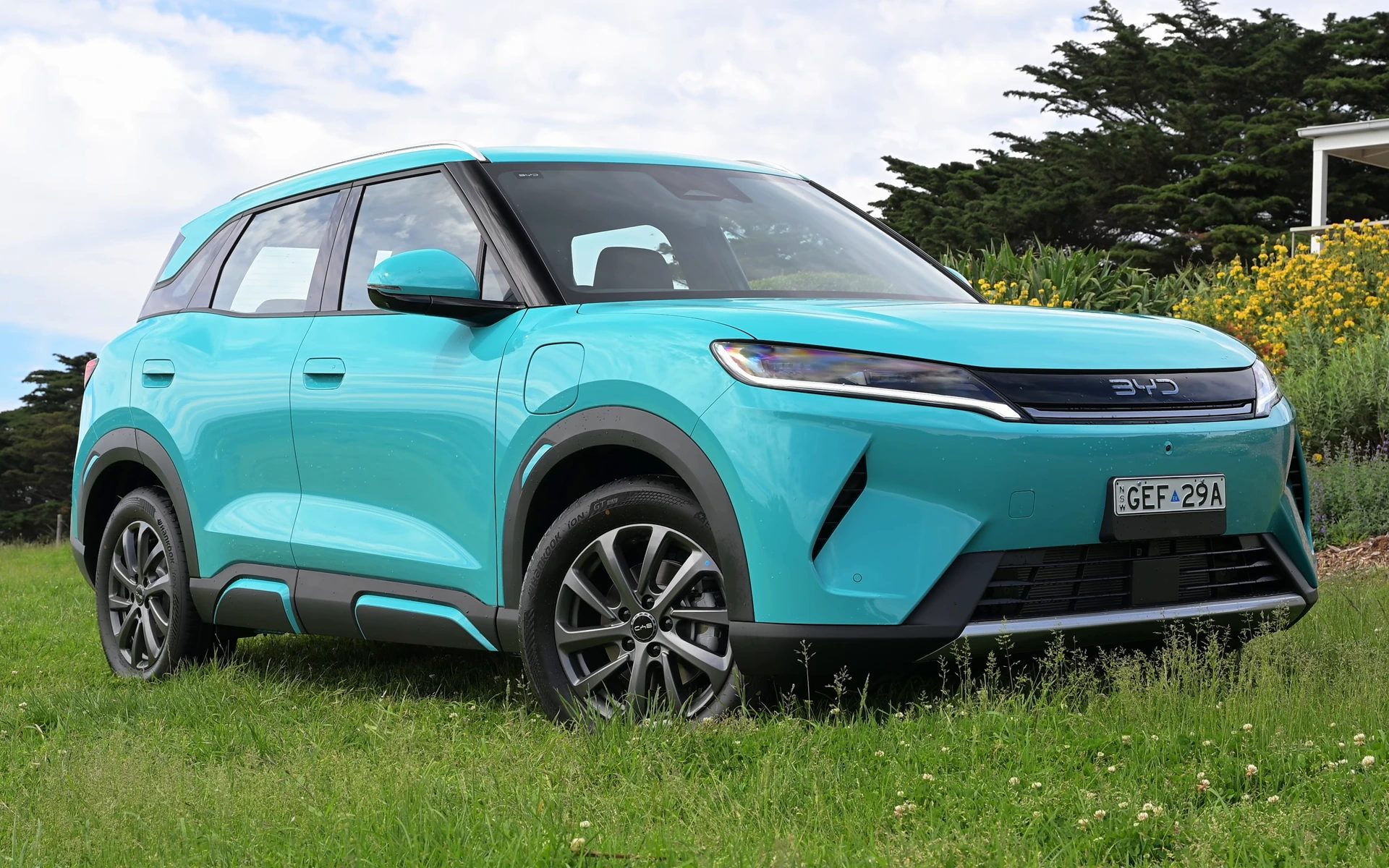
The Atto 2 DM-i avoids looking like a bargain-bin special. Long LED headlights, a largely closed-off nose and a tidy SUV profile give it enough identity without turning every panel into a talking point.
At 4330mm long, 1830mm wide and 1675mm tall, it's genuinely compact. The Premium's 17-inch alloys suit the proportions, while body-coloured details within the lower cladding prevent the sides from becoming a wall of black plastic.
Turquoise certainly makes a statement, though we'd choose a quieter colour. Roof rails add a useful-looking finishing touch, and the flush-looking door handles still operate mechanically rather than requiring an elaborate powered presentation.
At the rear, the LED light bar incorporates BYD's looping Mobius-knot motif. The DM-i badge is the obvious clue that this isn't the electric Atto 2, while a rear wiper handles a more mundane but important job.
There are sensible economies rather than embarrassing omissions. Rear privacy glass and a powered tailgate aren't included, but LED lighting is standard across both grades. The Premium's front sensors and clear surround-view camera also make the small footprint easier to place.
The door shuts on your budget-car expectations
The first surprise is the solid sound of the door closing. The second is the amount of soft-touch material inside: padded surfaces, comfortable armrests and synthetic leather that doesn't immediately advertise the price. The cabin feels well assembled, and its quietness helps reinforce that impression.
The Premium's front seats are particularly good. There's useful built-in thigh support even without an extending cushion, and the driver's seat has six-way electric adjustment. Heating is included, while the panoramic glass roof has a sunshade and straightforward touch controls rather than making you hunt through a menu.
A 12.8-inch rotating touchscreen replaces the Essential's 10.1-inch unit. Response is quick enough, wireless Apple CarPlay and Android Auto are standard, and the climate controls remain accessible while phone mirroring is running. Three-finger gestures for temperature and fan speed are a handy shortcut once learned.
The 8.8-inch instrument display is more functional than fancy, but the steering wheel gets clearly labelled physical buttons. A column-mounted gear selector frees up console space, and dedicated controls cover drive modes, audio volume and switching between EV and hybrid operation. Single-zone automatic climate control is standard, though the Chery Tiggo 4 Hybrid offers dual-zone adjustment.
Storage includes a large glovebox, useful door bins, two cupholders and a lower tray with USB-A and USB-C connections. The Premium also gets a 50W wireless phone charger, ambient lighting and an eight-speaker stereo that sounds very good for this money. The centre armrest lid is unnecessarily stiff to open, but that's a small irritation in a cabin that gets the fundamentals unusually right.
Small outside isn't the whole story
The rear seat is more accommodating than the exterior dimensions suggest. Legroom is generous for this class, there's useful space for feet beneath the front seats, and headroom remains excellent.
The bench is comfortable rather than merely tolerable. Reclining backrests give passengers some flexibility, and the panoramic roof helps the Premium feel airy without turning the second row into a cramped glasshouse.
Material quality holds up reasonably well, too. There are some harder plastics, but soft-touch areas remain where they matter, and the solid feel of the doors isn't reserved for front occupants.
A USB-A port, a USB-C fast-charging connection and map pockets cover everyday device and storage needs. The omissions are one rear air vent rather than a pair, and no fold-down centre armrest. Neither ruins the packaging, though both are reminders that this is still a price-conscious small SUV.
The petrol version finds another 45 litres
The Atto 2 DM-i holds 425 litres behind the rear seats, which is 45 litres more than the electric version. For a small SUV carrying both a petrol engine and a useful-sized battery, that's a respectable result.
The space is fairly wide, with useful recesses at the sides and some additional storage beneath the floor. Folding the rear seats increases capacity to approximately 1335 litres, giving the little BYD a practical second role when passengers aren't coming along.
It isn't the class champion on volume. The Chery Tiggo 4 Hybrid offers 470 litres and the MG ZS Hybrid+ has 443 litres, although the BYD comfortably exceeds the roughly 255-litre boot in the GWM Haval Jolion Hybrid.
The tailgate is manually operated, and there's a tyre repair kit rather than a spare wheel. Braked towing capacity is a modest 750kg, so this isn't a substitute for a larger SUV if trailer duties feature heavily in the buying decision.
Quiet assistance still needs a crash-test result
The Atto 2 DM-i has not yet been rated by ANCAP or Euro NCAP. A generous equipment list cannot substitute for independent crash testing, and buyers prioritising an established result should keep that distinction in mind.
Both grades include six airbags, autonomous emergency braking, adaptive cruise control, lane-centring, lane-departure assistance, blind-spot monitoring and rear cross-traffic alert. Traffic sign recognition and tyre pressure monitoring are also standard.
Parking assistance is unusually generous at the entry price. Every Atto 2 DM-i gets rear sensors and a 360-degree camera, with the Premium adding front parking sensors. The camera image is clear and useful, rather than a box-ticking feature that's difficult to interpret.
On our drive, the assistance systems were refreshingly restrained, without an intrusive driver-monitoring chime or repeated overspeed bongs. The adaptive cruise generally worked well, but consistently held the displayed speed around 2km/h below the set point: selecting 60km/h resulted in about 58km/h. It's an odd calibration quirk rather than a reason to reject the car.
The MG ZS Hybrid+ offers a five-star ANCAP result from 2025, while the GWM Haval Jolion Hybrid carries an older five-star result from 2022. The Chery Tiggo 4 Hybrid is also unrated, so the BYD isn't alone here, but its eventual crash-test performance remains an important unanswered question.
The extra battery buys more than kilometres
Both grades combine a naturally aspirated 1.5-litre four-cylinder petrol engine producing 72kW and 122Nm with a front electric motor rated at 145kW and 300Nm. The DM-i system drives the front wheels, with the petrol engine working primarily as a generator. Those individual outputs aren't simply added together: the Premium delivers a maximum system output of 156kW and 300Nm, compared with 122kW and 300Nm in the Essential.
The difference comes from the larger battery's ability to discharge more power. The Premium's 18.03kWh LFP Blade battery also provides a claimed 90km WLTP electric range, against 39km from the Essential's 7.85kWh pack. A short-distance commuter could still use the Essential effectively, but the Premium offers much more breathing room before petrol becomes part of the daily routine.
BYD claims 0–100km/h in 7.5 seconds for the Premium. During our acceleration runs, the car's own timer showed roughly seven seconds in HEV and Sport mode, but that wasn't an independently verified GPS result. The defensible conclusion is that it feels properly brisk and broadly consistent with the claim; even in electric mode, acceleration is more than adequate.
The claimed combined fuel figure is 0.7L/100km, alongside claimed electrical consumption of 15.0kWh/100km. That fuel number relies on the plug-in hybrid test cycle and regular charging, not endless petrol-only driving. With the battery held at 70 per cent during the test, the display showed approximately 5.7L/100km on both freeway and urban running, close to BYD's 5.6L/100km depleted-battery claim. This wasn't a full-battery-to-empty range test.
Charging is the clear limitation. Both grades accept a maximum of just 3.3kW AC through a Type 2 connection, and neither supports DC fast charging. The Premium takes around six hours from 15 to 100 per cent, which suits an overnight routine but makes a quick public-charging stop of limited use. The driver's-side charge port is also less convenient when the charging point is at the kerb.
The Premium adds 3kW vehicle-to-load capability for powering external equipment. Petrol goes into a 45-litre tank and must be 95 RON premium unleaded. Without regular access to a plug, a conventional hybrid deserves a close look: the MG ZS Hybrid+ claims 4.7L/100km and has returned around 4.3L/100km in separate testing, though those figures aren't a direct same-route comparison.
A bargain that knows what to do with a corner
The Atto 2 DM-i Premium drives with considerably more polish than its price suggests. Power delivery is immediate and predominantly electric in character, with little hesitation when pulling away or filling a gap in traffic. Switching between EV and HEV operation is straightforward through the console control.
The petrol engine rarely drew attention to itself on our test loop. More importantly, the system avoids the awkward changes in response that can make some hybrids feel indecisive. At low speeds in EV mode, the Premium is quiet and easy to drive smoothly.
The suspension has a firm edge rather than a pillowy ride. Its torsion-beam rear layout doesn't prevent it feeling settled, and it avoids the prolonged bouncing that can undermine an otherwise comfortable budget SUV. Around town, the ride is composed without pretending every surface is perfectly smooth.
Corners reveal another pleasant surprise. The body stays controlled, the Hankook Ion GT tyres provide a reassuring foundation, and the front end responds willingly enough for a small family SUV. Sport mode adds steering weight, although extra heft shouldn't be mistaken for sports-car feedback.
The result is an everyday car with consistent manners rather than one standout trick. The cabin remains reasonably quiet, acceleration is useful without needing a theatrical build-up, and the chassis feels comfortable with the available performance. It's a substantial improvement on the experience that made the Atto 1 a concern going into this drive.
The service bill isn't quite as cheap as the car
Finance or novated lease this BYD Atto 2 DM-i
Get a free, no-obligation quote from our finance partner, Loan Options — for straightforward car finance, or package this car through your salary with a novated lease.
BYD covers the Atto 2 DM-i with a six-year, 150,000km vehicle warranty. The high-voltage battery has separate eight-year, 160,000km coverage, and 12 months of roadside assistance is included.
Scheduled servicing falls due every 12 months or 20,000km, whichever comes first. The first five services cost $270, $490, $270, $930 and $270, for a total of $2230. That fourth visit is worth budgeting for rather than assuming every annual service will be inexpensive.
Those costs aren't disastrous, but they weaken the bargain story. The Chery Tiggo 4 Hybrid's five-year servicing totals $1495, while the GWM Haval Jolion Hybrid comes in at $2075. Both also offer seven-year, unlimited-kilometre warranties, as does the MG ZS Hybrid+.
Running costs will depend heavily on charging access and electricity prices. Regular overnight charging lets the Premium spend more time using its larger battery, while infrequent charging leaves you buying 95 RON petrol and carrying the plug-in hardware without using its main advantage. We'd establish a workable home or workplace charging routine before choosing it over a regular hybrid.
What do you get with the BYD Atto 2 DM-i
Essential
- 122kW/300Nm plug-in hybrid system with front-wheel drive
- 7.85kWh LFP Blade battery and 39km claimed WLTP electric range
- 3.3kW AC charging
- 16-inch alloy wheels
- LED headlights and tail-lights
- Rain-sensing wipers and heated mirrors
- Cloth seats and six-way manual driver's seat adjustment
- Polyurethane steering wheel
- 8.8-inch digital instrument display
- 10.1-inch rotating touchscreen
- Wireless Apple CarPlay and Android Auto
- DAB+ radio and four-speaker audio
- Over-the-air software updates
- Single-zone automatic climate control
- Keyless entry with NFC card
- 360-degree camera and rear parking sensors
- Six airbags, AEB and adaptive cruise control
- Lane-centring, lane-departure assistance and blind-spot monitoring
- Rear cross-traffic alert, traffic sign recognition and tyre pressure monitoring
Premium
- System power increased to 156kW, with 300Nm torque
- 18.03kWh LFP Blade battery and 90km claimed WLTP electric range
- 17-inch alloy wheels with Hankook Ion GT tyres
- Roof rails and power-folding mirrors
- Synthetic leather upholstery and steering wheel trim
- Six-way power-adjustable driver's seat
- Heated front seats
- Larger 12.8-inch rotating touchscreen
- Eight-speaker audio system
- 50W wireless phone charger
- Ambient interior lighting
- Panoramic glass roof with sunshade
- 3kW vehicle-to-load capability
- Front parking sensors
Final thoughts on the 2026 BYD Atto 2 DM-i
The Atto 2 DM-i Premium is an unusually complete cheap car. Its appeal isn't confined to a long equipment list: the comfortable seats, solid cabin, useful boot and composed driving manners all contribute something that survives beyond a showroom comparison.
The Premium is the version we'd buy. Its larger battery changes how useful the plug-in hybrid system can be, and the extra performance and cabin equipment make the $5000 step easier to justify. The Essential's short electric range may suit a very specific commute, but it isn't the strongest expression of this car.
There are conditions attached. Charging is slow, servicing isn't class-leading, and an ANCAP result is still needed. Buyers without reliable access to a plug should take the regular-hybrid alternatives seriously rather than assuming the cheapest PHEV is automatically the cheapest car to run.
For someone who can charge overnight and wants electric daily driving without giving up petrol backup, though, this is a compelling package. At $29,990 before on-road costs, the Premium delivers far more polish than its price leads you to expect.