
2027 Ford Ranger Super Duty Review
The 2027 Ford Ranger Super Duty brings serious payload, excellent ride comfort and effortless off-road ability. Does its sluggish V6 spoil the package?

Exceptional factory load ratings, genuinely impressive off-road ability and a remarkably comfortable ride make the Super Duty a convincing heavy-duty workhorse. Its sluggish acceleration, occasional infotainment frustrations and substantial purchase price are real drawbacks, but they don't overshadow how comprehensively the chassis delivers.
Read why ↓$89,990
154 kW
600 Nm
Unrated
2027
- Huge factory payload and towing ratings
- Remarkably comfortable ride for a heavy-duty ute
- Excellent off-road traction and useful assistance technology
- Sluggish acceleration, particularly above 60km/h
- Tray and on-road costs push the price well beyond $100,000
- Occasional Apple CarPlay frustrations
Intro
The 2027 Ford Ranger Super Duty answers a fairly specific question: what happens when a regular dual-cab ute isn't enough, but a much larger American pick-up isn't the right tool either? Ford's answer brings a 4500kg GVM, 4500kg braked towing capacity and a chassis built for substantially harder work.
Those numbers are impressive. The bigger surprise is how little punishment comes with them. This is a genuinely comfortable ute on rough roads, and its heavy-duty hardware doesn't stop it feeling composed through corners or remarkably manageable off-road.
Our test covered road driving, a wet-surface acceleration run and a thoroughly rain-soaked off-road course in a Double Cab Cab-Chassis fitted with a tray. A Toyota LandCruiser 79 Series provided a useful reference point, but the Ford quickly established an identity beyond simply being a more modern alternative. We also took a closer look at its engineering in our first-look video.
There is a catch, and it's under the bonnet. The V6 diesel has plenty of torque on paper, yet acceleration feels distinctly ordinary. Fortunately, the rest of the package makes a much stronger argument.
How much does the Ford Ranger Super Duty cost?
Finance or novated lease this Ford Ranger Super Duty
Get a free, no-obligation quote from our finance partner, Loan Options — for straightforward car finance, or package this car through your salary with a novated lease.
The Super Duty is expensive if you judge it as a base-trim Ranger. Judge it as a factory-engineered heavy-duty work vehicle, complete with substantial load ratings and comprehensive off-road hardware, and the value becomes considerably easier to defend.
2027 Ford Ranger Super Duty Pricing
These prices include GST but exclude dealer delivery and on-road costs. Cab-chassis models also exclude a tray, which is a significant addition rather than a small finishing expense.
Ford trays run from roughly $6,000 to $9,000 depending on cab configuration and finish. Our Double Cab test vehicle, fitted with an approximately $6,000 tray, came to about $103,000 drive-away. The equivalent Single Cab figure was approximately $97,680 drive-away.
Against that, the 2027 Toyota LandCruiser 79 Series GXL Double Cab automatic costs $84,800 before on-road costs, with an indicative drive-away price of around $95,000 including its standard tray. The Toyota is cheaper, but it also carries and tows less, and its cabin is considerably more basic. The 2027 Ram 1500 Express Black Edition starts at $109,950 before on-road costs and matches the Ford's maximum towing rating, but not its cab-chassis payload.
We reckon the standard-grade Super Duty makes the strongest case for buyers who actually need the capacity. Adding luxury trim and accessory packs can quickly inflate the bill; the core engineering is already there without them.
- Single Cab Cab-Chassis 4x4 $82,990
- Super Cab Cab-Chassis 4x4 $86,490
- Double Cab Cab-Chassis 4x4 $89,990
- Double Cab Pick-Up 4x4 $93,990
- Double Cab Cab-Chassis XLT $95,990
- Double Cab Pick-Up XLT $99,990
Got a car to sell or trade in?
Get competing offers from dealers with CarSauce Sell. Free, no obligation.
Get my offersThe big shoulders have a proper job
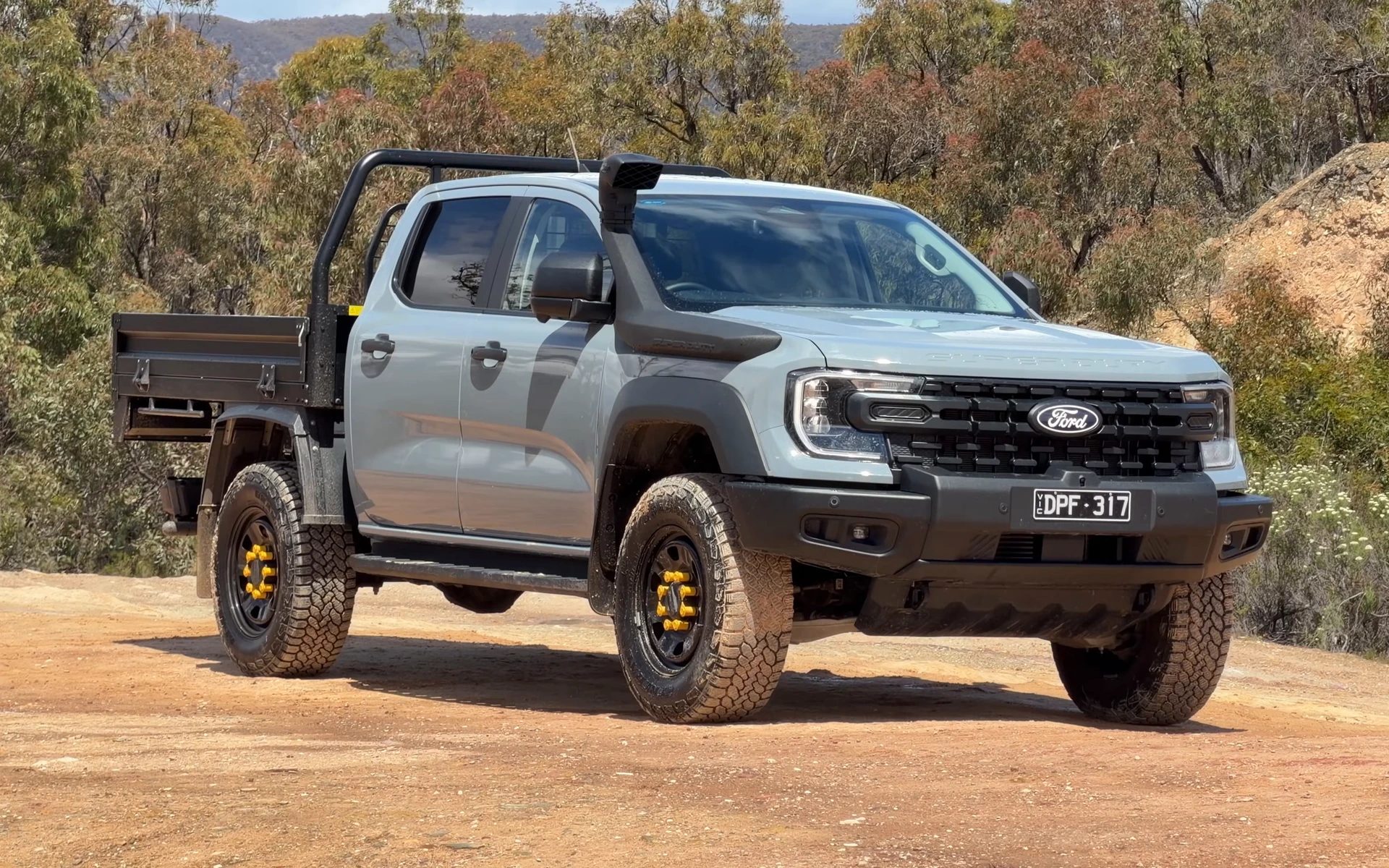
The Super Duty looks substantial because it is. At 5470mm long, 2032mm wide and 1985mm tall, it occupies roughly Ranger Raptor territory rather than the footprint suggested by an ordinary work-spec Ranger.
Its squared-off wheel openings aren't just styling theatre. They provide clearance as the wheels articulate, while the pronounced bonnet and embossed Super Duty lettering make the heavy-duty identity obvious. The composite side steps and plastic door handles are less glamorous, but this isn't pretending to be a luxury ute.
The 18-inch wheels use eight studs, with LT275/70 R18 General Grabber all-terrain tyres adding to the purposeful stance. Equal 1710mm front and rear tracks also avoid the mismatched track widths that remain a talking point on the LandCruiser 79 Series.
There is plenty of substance behind the bodywork: a thicker chassis frame, heavier-duty axles, a frame-mounted steel front bumper and substantial steel underbody protection. The factory snorkel is sealed and uses a Safari-designed modular head, supporting an 850mm wading rating.
Traction Green is among the $750 prestige paint options, although the grey test car suited the no-nonsense brief. More importantly, the large mirrors are useful rather than ornamental. This design largely earns its bulk.
Work boots welcome, stone-age ergonomics not required
The front cabin is where the Super Duty most clearly separates itself from the traditional heavy-duty ute experience. The driving position is straightforward, the controls are sensibly arranged and the manually adjustable cloth seats are genuinely comfortable. Basic trim doesn't mean basic accommodation.
A 12-inch portrait touchscreen runs Ford's SYNC 4A system, accompanied by an 8-inch digital instrument cluster. Wireless Apple CarPlay and Android Auto, wireless phone charging and dual-zone climate control are standard. Keyless entry and push-button start also make this feel like a current vehicle rather than an old workhorse with a newer engine.
During our test, Apple CarPlay occasionally refused to behave properly. That's irritating in any vehicle, and particularly in one costing six figures on the road. The system still offers vastly more functionality than the LandCruiser's basic cabin, but familiarity with Ford's interface doesn't excuse connection problems.
Storage is well considered, with dashboard cupholders, upper storage and a useful glovebox arrangement. A six-switch auxiliary bank caters for added equipment, while a chassis-connected dashboard mounting provision is designed for the sort of screens and devices used in demanding work environments.
The standard vinyl floor makes sense here, and the cabin doesn't need leather to fulfil its brief. XLT adds leather-accented upholstery and heated and ventilated front seats, but the base vehicle already covers the essentials convincingly.
The crew gets more than an afterthought
The Double Cab's rear accommodation feels recognisably Ranger-like rather than compromised by the Super Duty's work focus. That is a meaningful advantage if the back seat regularly carries adults rather than jackets and tool bags.
Compared with the cramped second row of the LandCruiser 79 Series Double Cab, this is a much more usable place to spend time. The broader cabin appeal matters for crews travelling between sites, and for owners expecting one vehicle to cover work and family duties.
Rear air vents are included, along with USB-A and USB-C connections and a 230V outlet. Those are useful inclusions rather than luxuries, especially when passengers need to charge equipment during the day.
The rear seat base lifts to reveal storage underneath, helping keep smaller items out of sight and away from the footwells. ISOFIX points and top-tether anchorages are also fitted to the five-seat Double Cab.
We'd choose the Double Cab if carrying people is a regular part of the job. The Single Cab and Super Cab offer higher payload figures, but the rear-seat usefulness here is a substantial part of the Ford's everyday appeal.
Big capacity still needs careful arithmetic
This is the section that explains why the Super Duty exists. Every variant has a 4500kg GVM, 8000kg GCM and 4500kg braked towing rating, backed by heavier-duty structural and driveline components rather than a cosmetic equipment package.
Cab-chassis payload is quoted at 1982kg for the Single Cab, 1885kg for the Super Cab and 1825kg for the Double Cab. Those figures exclude the tray. Fit a tray, accessories, passengers and equipment, and the available carrying capacity reduces accordingly; the Double Cab's headline number is not what remains after completing a touring build.
For context, the LandCruiser 79 Series Double Cab offers 1310kg of payload, a 3510kg GVM, 7010kg GCM and 3500kg braked towing. The Ram 1500 Express Black Edition matches the Ford's 4500kg towing rating, but its quoted 1014kg payload serves a different set of priorities.
The Ford's maximum ratings cannot all be used at once. A vehicle at its full 4500kg GVM plus a 4500kg trailer would exceed the 8000kg GCM, so actual vehicle mass, trailer mass, towball download and axle loads still need careful checking. Onboard Scales and Smart Hitch help with loading and distribution, but they don't remove those limits.
The tray-equipped test vehicle offers the flexibility expected of a cab-chassis, while Pick-Up buyers get a thicker tub floor and a different bed liner. Pro Power Onboard supplies a 400W 230V inverter for compatible equipment. Our test didn't include towing, so the trailer figures here are rated capabilities, not a verdict on how it behaves with 4.5 tonnes behind it.
The payload rating forgot to ruin the ride
A ute with this much carrying capacity should, by conventional expectations, feel fairly uncompromising without a heavy load. The Super Duty doesn't. Its ability to absorb rough road surfaces is the standout surprise of the drive.
Even on an ordinary, imperfect road, the suspension controls the body without delivering the harshness its heavy-duty springs might suggest. This is genuinely comfortable transport, not simply comfortable by the standards of industrial equipment.
The chassis also feels solid and well controlled. There is some body roll through corners, as expected from a tall work ute, but it doesn't turn into the loose, cumbersome experience the dimensions might imply. The steering and overall responses make road driving much less tiring than in the LandCruiser 79 Series.
On our test route, the Ford felt generations ahead of that rival for refinement and chassis composure. Its width remains something to account for on narrow roads and in parking spaces, but the driving experience is far more approachable than the specification sheet suggests.
The engine is the limiting factor. Asking for more speed exposes the sluggishness again, particularly once already travelling above suburban speeds. The suspension and chassis feel capable of considerably more than the drivetrain's acceleration delivers.
The assistance is comprehensive; the rating is absent
The Ranger Super Duty is not rated by ANCAP. The regular Ranger's five-star result does not apply to it, and buyers should not treat the shared name or familiar cabin as evidence otherwise.
Standard driver assistance is nevertheless extensive. Intelligent Adaptive Cruise Control includes Stop & Go and lane centring, while autonomous emergency braking includes pedestrian detection. Evasive Steer Assist and Lane Keeping Aid are also fitted.
Blind-spot monitoring includes trailer coverage, alongside rear cross-traffic alert, a 360-degree camera and front and rear parking sensors. Importantly, the safety equipment isn't restricted to Pick-Up models; the cab-chassis configuration retains the camera and sensor support when equipped with the compatible Ford tray arrangement.
That makes a considerable difference in a vehicle this size. The camera views were particularly useful off-road, where the bonnet can obscure the terrain immediately ahead. The parking sensors could also be switched off when their warnings became unhelpful during the water crossing.
This first drive demonstrated the usefulness of the visibility aids rather than establishing how every intervention behaves across daily traffic. The equipment list is strong, and XLT isn't required to access it, but an independent crash-test result remains a separate question.
Six cylinders, but not much hurry
The 3.0-litre V6 turbo-diesel produces 154kW at 3250rpm and 600Nm at 1750rpm. That's 30kW less than a regular Ranger V6, with the same peak torque, and the Super Duty also has substantially more vehicle to move.
A 10-speed automatic feeds a full-time four-wheel-drive system with low range and no two-wheel-drive mode. Heavy-duty Euro VI emissions compliance brings AdBlue, while driver-initiated diesel particulate filter regeneration is another work-focused addition. Cooling capacity has increased by about 25 percent.
None of that disguises the lack of urgency. Initial traction is strong and the engine gets the ute moving without drama, but above roughly 60km/h it starts to feel short of power. Acceleration tails off noticeably as road speed rises.
On our wet-surface run, the Super Duty reached 100km/h in 12.71 seconds. The LandCruiser 79 Series single cab managed 11.19 seconds in the same comparison, although its different body configuration and lower weight mean this isn't an identical-specification contest. It still reinforces the seat-of-the-pants impression: the Ford isn't particularly quick.
The additional cooling and work-focused calibration suit the Super Duty's intended role, but they aren't proof of long-term reliability. Equally, a useful fuel-consumption verdict needs more distance and representative loads than this first drive delivered. For now, the engine is adequate rather than a highlight.
Rain made the course harder, not the Ford
Heavy rain turned the off-road course into a proper test of traction and control, with muddy sections, rocks, running water and a steep climb. The Super Duty dealt with it all with surprisingly little drama. More importantly, it made the process straightforward rather than demanding constant correction.
Low range engaged promptly, and the front and rear differential locks activated without the back-and-forth manoeuvring required by the LandCruiser during the comparison. The Ford remained stable over uneven ground, with its independent front suspension and live rear axle delivering a much more comfortable experience than the hardware's load ratings might suggest.
Rock Crawl mode automatically engaged the rear differential lock and softened throttle response usefully. It allowed measured progress over the rocks without needing the front locker for that section. Conditions had deteriorated by then, yet the Ford still felt composed and predictable; both vehicles retained their road tyre pressures for the exercise.
Visibility directly over the large bonnet isn't brilliant, but the front camera view makes it much easier to judge the ground immediately ahead. Trail Turn Assist also proved useful, braking the inside rear wheel to help negotiate a tight turn that would otherwise have required reversing. Trail Control maintained a selected crawling speed, reducing the workload on the steep terrain.
The Double Cab has 295mm of ground clearance, with approach, departure and breakover angles of 36.1, 28.6 and 26.3 degrees respectively. Its 850mm rated wading depth exceeds the LandCruiser's approximately 700mm figure. The water crossing and wet hill caused no difficulty during our test, although that shouldn't be confused with measuring the maximum wading limit.
The Toyota also completed the course, so this wasn't a case of one vehicle making it and the other failing. The Ford's advantage was how easily, comfortably and consistently it managed the obstacles. That's a meaningful benefit when difficult terrain is part of a working day rather than a weekend challenge.
Budget for the job, not just the badge
Finance or novated lease this Ford Ranger Super Duty
Get a free, no-obligation quote from our finance partner, Loan Options — for straightforward car finance, or package this car through your salary with a novated lease.
The first ownership expense to account for is completing the vehicle. Cab-chassis pricing excludes a tray, and that purchase also consumes some payload. A heavily accessorised Super Duty can therefore cost considerably more and carry less than the headline figures initially suggest.
The options list shows how quickly a specialised build can grow. Rock sliders and a dual-battery option each cost $1,850, while Ford's accessory packs range from roughly $7,251 for the least expensive Work Pack configuration to $21,294 at the upper end of the Adventure Pack range. Equipment should follow the job rather than simply fill every available mounting point.
The diesel's AdBlue system adds another consumable to monitor. Driver-initiated DPF regeneration is a useful provision for work patterns that can make particulate-filter management more demanding, though it doesn't remove the need to follow the vehicle's operating and maintenance instructions.
Long-term durability is the remaining big question. The thicker chassis, heavier-duty axles and increased cooling are encouraging engineering measures, but a successful first drive cannot establish years of reliability. That's where the LandCruiser's established reputation still carries weight.
We'd prioritise the correct tray, necessary protection and a carefully calculated load plan before spending on cosmetic or comfort upgrades. The base cabin is already comfortable enough that there is no pressing need to climb the range simply to make the vehicle liveable.
What do you get with the Ford Ranger Super Duty
Super Duty
- Single Cab, Super Cab and Double Cab cab-chassis configurations, plus Double Cab Pick-Up
- 3.0-litre V6 turbo-diesel producing 154kW and 600Nm
- 10-speed automatic and full-time four-wheel drive with low range
- Front and rear locking differentials
- Normal, Eco, Tow/Haul, Slippery, Mud/Ruts, Sand and Rock Crawl drive modes
- Trail Control and Trail Turn Assist
- 18-inch eight-stud steel wheels with LT275/70 R18 General Grabber all-terrain tyres
- Full-size spare wheel
- Sealed Super Duty snorkel, with no-cost delete option
- Frame-mounted steel bumper, rated recovery points and steel underbody protection
- Automatic LED headlights, fog lights and rain-sensing wipers
- Keyless entry, push-button start and privacy glass
- Manually adjustable cloth seats and vinyl flooring
- Dual-zone climate control
- 12-inch SYNC 4A touchscreen and 8-inch digital instrument cluster
- Wireless Apple CarPlay and Android Auto, wireless charging and FordPass
- Six-switch auxiliary bank and Pro Power Onboard 400W 230V inverter
- Onboard Scales and Smart Hitch
- Adaptive cruise control with Stop & Go and lane centring
- AEB with pedestrian detection, Evasive Steer Assist and Lane Keeping Aid
- Blind-spot monitoring with trailer coverage and rear cross-traffic alert
- 360-degree camera, off-road front camera view and front and rear parking sensors
- Double Cab models include five seats, rear vents, ISOFIX points and top-tether anchorages
Super Duty XLT
- Available in Double Cab Cab-Chassis and Double Cab Pick-Up configurations
- Super Duty-branded 18-inch eight-stud alloy wheels
- Leather-accented heated and ventilated front seats
- Leather-accented rear seats
- Carpet flooring and front all-weather mats
Final thoughts on the 2027 Ford Ranger Super Duty
The 2027 Ford Ranger Super Duty delivers on the difficult part of its promise. It combines serious factory load ratings with a comfortable ride, useful cabin technology and excellent off-road capability. Those strengths don't usually arrive together without substantial compromise.
The engine is that compromise here. Its modest acceleration becomes particularly apparent above 60km/h, and neither six cylinders nor 600Nm changes that impression. Occasional CarPlay trouble is a smaller irritation, while long-term reliability still needs time rather than confident predictions.
Nevertheless, the overall package is deeply convincing for buyers who need more capacity than an ordinary ute provides. The standard-grade Double Cab is comfortable enough to use daily, and its off-road systems genuinely reduce effort rather than merely decorate the touchscreen.
We'd choose the Super Duty over the LandCruiser 79 Series for this mix of work capability, comfort and usability. It isn't the right purchase for someone who only wants the look of a heavy-duty ute, but for those who can put its engineering to work, it earns its A grade.