
2027 Honda Avancier RS Review: First Look
The 2027 Honda Avancier RS brings six seats, hybrid AWD and a plush cabin. Our first look explores its practicality ahead of its April Australian launch.

A provisional first-impressions grade for the Avancier's design, cabin and practicality. The six-seat layout and plush interior impress, but adult third-row comfort is compromised. Pricing, driving performance, efficiency and ownership costs remain unassessed.
Read why ↓- Distinctive styling gives Honda a proper flagship presence
- Plush cabin with spacious second-row captain's chairs
- Useful-looking boot and clever two-level underfloor storage
- Third-row adults sit knees-up with limited legroom
- Six-seat layout sacrifices a place against seven-seat rivals
- Pricing and key specifications remain unannounced
Intro
Honda is making room at the top of its Australian range again. The 2027 Honda Avancier is a large, three-row hybrid SUV with six seats, electric all-wheel drive and a cabin that makes a fairly convincing first argument for flagship status.
It also looks nothing like a CR-V with extra bodywork. A new Honda badge, angular styling and animated lighting introduce a different design direction, while second-row captain's chairs put a clear emphasis on passenger comfort rather than squeezing in the maximum number of people.
The Avancier is scheduled to arrive in April 2027, returning Honda to territory it last occupied roughly two decades ago with the MDX. Its obvious shopping-list neighbours include the Mazda CX-80, BYD Sealion 8 and Toyota Kluger.
There is an important distinction here: this is a static first look, not a road test. Our time with the pre-production, right-hand-drive RS was limited to a studio inspection, with the car switched off. The provisional scores cover what can reasonably be judged standing beside it and sitting inside it; the hybrid system and driving experience will have to earn their marks later.
How much does the Honda Avancier cost?
Finance or novated lease this Honda Avancier
Get a free, no-obligation quote from our finance partner, Loan Options — for straightforward car finance, or package this car through your salary with a novated lease.
The Avancier looks suitably upmarket, but whether it represents good value will depend on Honda's Australian pricing. Prices and the full grade line-up will be confirmed closer to the April 2027 launch; the RS shown here should not be treated as confirmation of the entire range.
2027 Honda Avancier Pricing
- Honda Avancier RS pricing to be announced
Honda positions the Avancier above the CR-V, whose current seven-seat offering costs $54,900 drive-away. That establishes its place in the showroom, not an Avancier starting price.
The surrounding market is competitive. The 2027 BYD Sealion 8 starts at $56,990 before on-road costs, the 2027 Mazda CX-80 range starts at $54,950 before on-road costs, and the 2027 Toyota Kluger Hybrid opens at about $62,410 before on-road costs. Those figures are not directly comparable with the CR-V's drive-away price.
The Honda's plush interior gives it something tangible to sell beyond hybrid hardware. Still, a convincing value verdict needs a price, a settled equipment list and a drive, not just a well-presented cabin.
Got a car to sell or trade in?
Get competing offers from dealers with CarSauce Sell. Free, no obligation.
Get my offersHonda's new badge has a much bigger stage
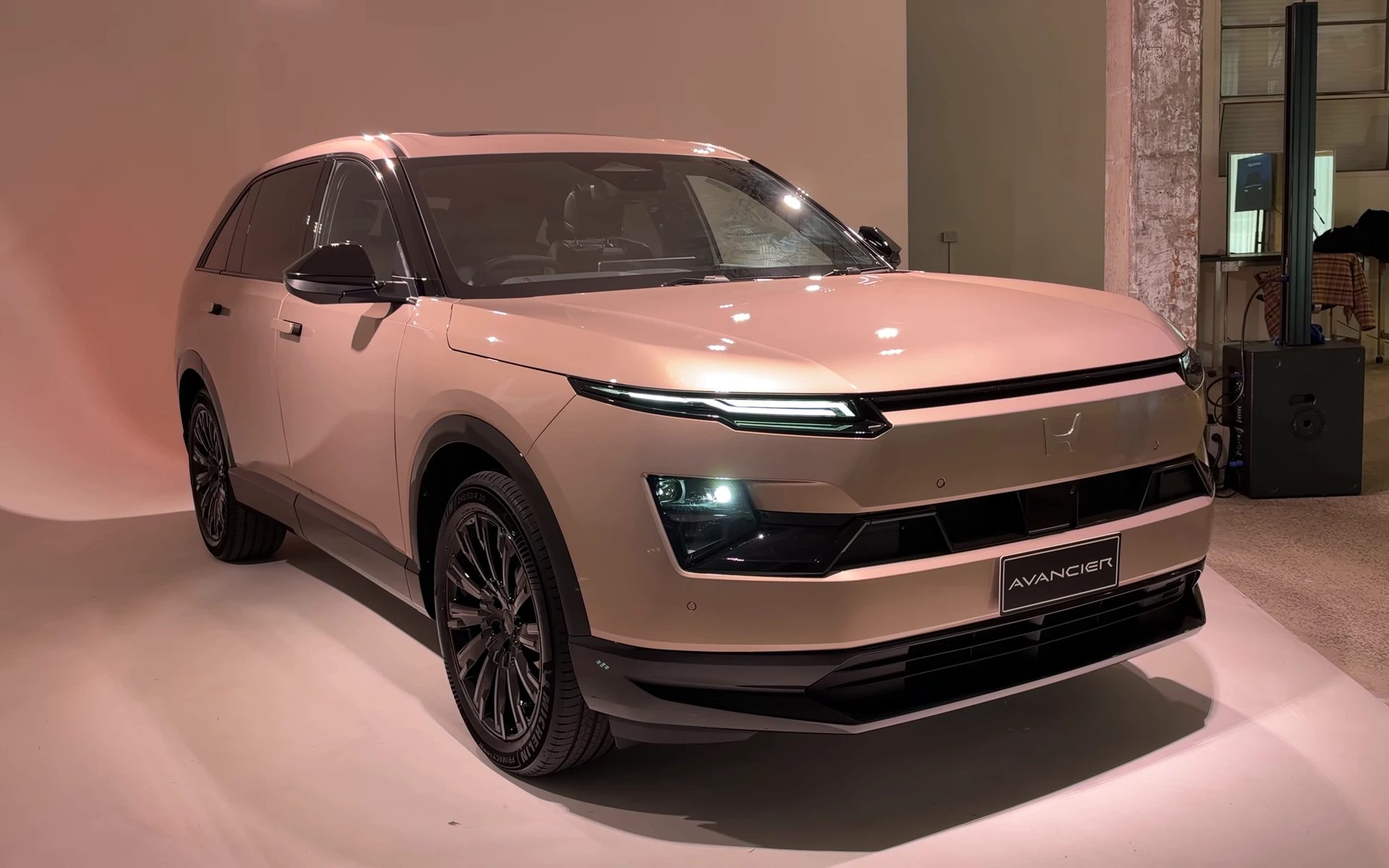
The Avancier makes a clean break from Honda's familiar SUV styling. Its broad front, slim lighting and angular body give it a more assertive presence, without relying on an enormous open grille to do the work.
The new Honda 'H' badge takes centre stage above a largely closed-off fascia. A full-width LED daytime running light treatment adds a start-up animation, with the front radar and camera integrated into the nose.
In profile, the long rear section makes the three-row packaging obvious. The RS wears 20-inch alloy wheels with Michelin Primacy 5 Energy tyres, black mirror caps, flush door handles and dark rear privacy glass. Official Australian dimensions are still to come, but there is no mistaking this for a compact SUV.
The rear is arguably its strongest angle. A full-width light bar has a three-dimensional effect, the rear wiper is tucked beneath the spoiler, and the new badge sits above prominent Avancier lettering. Gloss-black lower bumper trim is less distinctive, though it suits the RS treatment.
We reckon the design does an important job: it makes the flagship look like a separate proposition, rather than simply a larger version of the car below it.
The soft trim makes the first impression, not the screen
The front cabin feels convincingly plush. Soft-touch surfaces extend across the dashboard, doors and centre-console areas, while leather upholstery with red stitching gives the RS a more premium character than a purely practical family hauler.
The front seats are particularly promising. They feel soft without lacking support, with generous under-thigh support and substantial lumbar adjustment. A flat-bottom steering wheel adds some visual interest without turning the whole cabin into a sports-car impersonation.
A large central touchscreen and separate digital driver display dominate the dashboard. Neither was operating during our inspection, so display quality, menu logic, response times and phone integration remain outside this assessment. A big panel is not automatically a good infotainment system.
The physical storage is easier to judge. There is a useful glovebox, a covered wireless charging area, cupholders and a sizeable centre storage compartment, along with USB-C ports and a 12V socket. Ambient lighting, Bose speakers and a large panoramic glass roof add to the presentation.
The Mazda CX-80 already makes an upmarket cabin a strong part of its appeal. The Avancier appears ready to compete on materials and seat comfort, although the Honda still needs to prove that its technology is as pleasant to use as its trim is to touch.
Two seats are the point of the second row
The Avancier's second row is built around two captain's chairs rather than a three-person bench. That is a deliberate trade: more individual accommodation, but only six seats overall.
Legroom and toe room are generous, and the seats have a substantial range of fore-and-aft movement to help distribute space between the rear rows. The cushioning is soft and comfortable, although the available recline is less expansive than the lounge-like presentation might suggest.
A substantial centre armrest arrangement incorporates cupholders and access to a rear screen or control panel. Its functions could not be assessed with the vehicle switched off, but the surrounding trim feels solid and the ambient lighting carries through from the front.
Rear air vents, USB-C ports, sunshades and soft map pockets cover several useful family-car basics. Seat adjustment switches on the side of the front passenger seat also allow rear occupants to alter the space ahead.
Against the seven-seat BYD Sealion 8 and Toyota Kluger, the missing middle seat will be decisive for some households. The Mazda CX-80 offers six- or seven-seat layouts, making it a particularly relevant alternative for buyers who want captain's chairs without moving into a people mover.
Getting into row three is easier than stretching out
Access to the third row is reasonably straightforward. The second-row seat folds and moves forward to create a usable opening, so climbing aboard does not demand quite the gymnastics that the long body might lead you to fear.
Once seated, headroom is sufficient and the cushioning is comfortable. The limiting factor is lower down: adults sit with their knees raised, and legroom depends on the second-row occupants giving up some of their space.
That sliding second row helps, but it does not create room from nowhere. Set the captain's chairs for maximum comfort and the occupants behind them draw the short straw; move them forward and the cabin becomes a negotiation between rows.
The rearmost seats also felt enclosed during the studio inspection, although the dark setting makes it unfair to draw a firm conclusion about daylight ambience. A proper family test will be more revealing than a brief sit.
On this first impression, the third row is more convincing for shorter trips than extended adult travel. The Mazda CX-80 also attracts criticism for a tight final row, so simply having a large exterior does not make either vehicle an automatic answer for six adults.
There's another compartment beneath the first one
The powered tailgate opens onto a useful-looking luggage area, even with all three rows in place. That matters in a six-seat SUV: fitting the passengers is only half the task if their bags have to stay home.
There is no official luggage volume yet, and a visual inspection cannot establish whether a particular pram or holiday load will fit. Still, the space behind the third row appears more useful than a token slot for a couple of soft bags.
Lift the floor and there is a storage compartment, followed by another level of storage beneath it. Those separate spaces should help keep smaller items out of the main load area rather than leaving everything loose around the luggage.
Folding the third row opens up substantially more carrying space. No spare wheel was visible during our inspection, so buyers who regularly travel outside major centres should check the production car's tyre-repair provision carefully.
The boot makes a promising first impression, but measured capacity, loading dimensions and a real-world luggage test are still needed. Towing capability also remains unannounced, which leaves another important family-SUV question open.
The road test still has to happen
The Avancier was not driven at this reveal. There is no road assessment here of ride comfort, steering, braking, cabin noise or the transition between petrol and electric propulsion.
That distinction matters because plush seats and soft door trim cannot establish how well a large SUV deals with broken bitumen. Nor can a 20-inch wheel and tyre package tell the whole story about suspension comfort.
Our eventual road test will need to establish whether the comfort promised by the cabin extends to passengers in all three rows. Urban manoeuvrability and the usability of the camera system will also matter in a vehicle with this much apparent bulk.
The competitive opportunity is clear enough: ride firmness is a criticism of the Mazda CX-80, while the BYD Sealion 8 has drawn criticism for aspects of its ride and driver-assistance calibration. The Honda has a chance to distinguish itself, but a static inspection cannot establish that it has done so.
Visible sensors aren't a safety verdict
The Honda Avancier is currently ANCAP unrated. Its flagship positioning and family focus do not substitute for an independent crash-test result.
The RS inspected has a front radar, a front-facing camera and a 360-degree camera system, with cameras visible beneath the exterior mirrors. That confirms the presence of hardware, not the complete list or operating parameters of its driver-assistance features.
Australian safety equipment and any differences between grades remain to be announced. It would be premature to assign specific assistance functions across an unconfirmed line-up.
The calibration matters as much as the feature count. Lane assistance, alerts and other interventions need to be assessed on Australian roads, while the surround-view system needs to be tested for image quality and usefulness in tight parking spaces.
A new hybrid system without the numbers yet
The Avancier introduces Honda's new Honda Hybrid system and a new electric all-wheel-drive arrangement. That is the extent of the confirmed mechanical picture for Australia at this stage.
Power, torque, battery capacity and fuel consumption have not yet been announced. There is consequently no basis for calling it quick, economical or especially capable simply because it carries hybrid and all-wheel-drive badges.
The Toyota Kluger Hybrid provides a relevant efficiency benchmark, with a claimed 5.6L/100km consumption figure. The BYD Sealion 8 takes a different approach as a plug-in hybrid, including a claimed electric range of up to 152km on the NEDC cycle for AWD versions; that should not be assumed to describe the Honda's capabilities.
For now, the sensible conclusion is that Honda has chosen a powertrain direction suited to its flagship brief. Whether the system delivers the smoothness, efficiency and effortless response buyers expect remains a question for the road test.
The ownership equation is still open
Finance or novated lease this Honda Avancier
Get a free, no-obligation quote from our finance partner, Loan Options — for straightforward car finance, or package this car through your salary with a novated lease.
Australian warranty coverage and servicing details for the Avancier have not yet been announced. Buyers should wait for the model's confirmed terms rather than assume that another Honda's ownership package will apply unchanged.
Fuel consumption is another significant missing part of the running-cost calculation. The new hybrid system may be central to the car's appeal, but there is no official economy figure or measured test result to attach a dollar saving to it.
The RS's 20-inch Michelin tyres are also worth including in a future ownership comparison. Replacement pricing will depend on the final tyre specification, and there is no useful saving or penalty to calculate yet.
A credible ownership verdict will need the purchase price, warranty terms, service intervals and costs, plus real-world fuel use. Until those are settled, the Avancier's premium presentation should not be confused with an established value proposition.
What do you get with the Honda Avancier
The Australian grade line-up and final standard-equipment list are still to be confirmed. The following features were present on the pre-production RS inspected; they are not a substitute for the final production specification.
RS
- Honda Hybrid powertrain with electric all-wheel drive
- Six seats in a 2+2+2 layout
- Second-row captain's chairs with sliding adjustment
- 20-inch alloy wheels with Michelin Primacy 5 Energy tyres
- Black mirror caps and flush door handles
- LED daytime running lights and full-width rear lighting with start-up animations
- Rear spoiler with concealed rear wiper
- Rear privacy glass
- Powered tailgate
- 360-degree camera system
- Front radar and camera hardware
- Large panoramic glass roof
- Large central touchscreen and digital driver display
- Flat-bottom steering wheel
- Leather upholstery with red stitching
- Ambient interior lighting
- Bose speakers
- Wireless phone charging area
- Front and rear USB-C ports
- 12V socket
- Second-row screen/control panel
- Second-row air vents and sunshades
- Front passenger seat adjustment switches accessible to rear occupants
- Folding third-row seats
- Two-level underfloor boot storage
Final thoughts on the 2027 Honda Avancier
The Honda Avancier makes a strong opening argument as a flagship. Its styling is distinctive, the front cabin feels genuinely plush, and the second-row captain's chairs give it a clear identity beyond being another large hybrid SUV.
There are practical compromises. Six seats will not suit every family, and the third row's raised-knee position and limited legroom temper the promise of that long body. The boot looks useful, but a proper luggage test is still required.
The larger questions remain the price, the new hybrid system, ride comfort and the final Australian equipment and ownership packages. None of those can be answered by a good first impression in a studio.
We would put it on the shortlist for buyers who value second-row comfort and want something more upmarket than Honda's existing family SUVs. A buying recommendation will have to wait until the Avancier is priced and driven; for now, this is a promising return to flagship territory, not a finished verdict.