
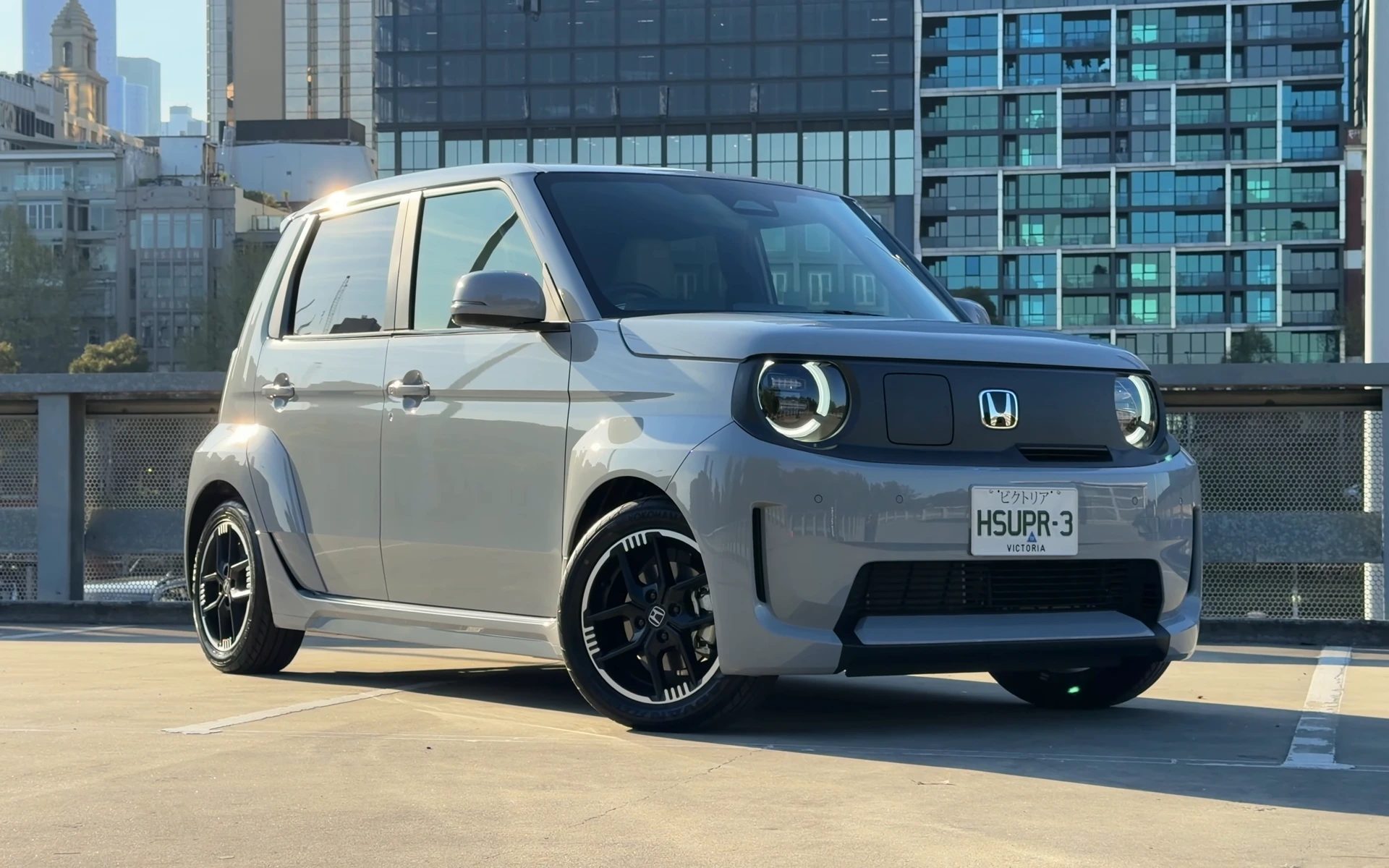
2027 Honda Super-ONE Mono Tone Review
The 2027 Honda Super-ONE trades range and bargain pricing for retro charm, playful fake gears and genuine city-car fun. Is that enough at $36,900 drive-away?

An A+ for delivering something genuinely desirable rather than simply inexpensive: a characterful, beautifully calibrated electric city car. Its range, packaging and safety-rating limitations keep the category scores grounded, but for an urban buyer chasing Honda charm and everyday fun, the Super-ONE gets the important things right.
Read why ↓$36,900
70 kW
162 Nm
Around 10–11kWh/100km observed in favourable urban driving; 202km claimed WLTP range
Unrated
2027
- Distinctive retro styling with genuine Honda character
- Playful Boost mode, responsive steering and polished controls
- Useful Magic Seats and generous front-cabin equipment
- Short 202km range limits longer-distance usefulness
- Four seats, a small boot and basic rear amenities
- No ANCAP rating; cheaper rivals offer more on paper
Intro
The 2027 Honda Super-ONE is a difficult car to justify with a calculator. It costs more than several larger electric hatchbacks, travels just 202km on the WLTP cycle and has a boot that would struggle to impress a shopping trolley.
Then you press the purple Boost button. The little Honda starts impersonating a combustion-powered performance car, the paddles become pretend gearshifters, and an otherwise ordinary city drive becomes considerably more entertaining.
Honda's first battery-electric vehicle in Australia isn't trying to win the small-EV specification contest. This four-seat hatch leans into retro Japanese design, compact proportions and the sort of driver involvement that doesn't require enormous power or an enormous budget.
After a first drive through Melbourne in the Luminous Gray Mono Tone for our video review, we reckon that approach works remarkably well. There are clear limits to its usefulness, but very little confusion about its appeal.
How much does the Honda Super-ONE cost?
Finance or novated lease this Honda Super-ONE
Get a free, no-obligation quote from our finance partner, Loan Options — for straightforward car finance, or package this car through your salary with a novated lease.
The Super-ONE is reasonably priced for a characterful indulgence, rather than especially cheap transport. Both versions sit below $40,000 drive-away, and the $500 step to Two Tone buys a different colour treatment rather than a meaningful equipment upgrade.
2027 Honda Super-ONE Pricing
These are national drive-away prices, including on-road costs. The Mono Tone tested here gets the same battery, Boost function, heated front seats, heated steering wheel and Bose audio as the Two Tone.
The comparison with mainstream small EVs is less flattering. The 2027 MG4 EV Urban Essence 54 costs $34,990 drive-away and claims 405km WLTP range. A 2027 BYD Atto 1 Premium offers five seats and 310km WLTP range for $27,990 before on-road costs, or approximately $31,400 drive-away in Victoria.
Even the entry Atto 1 Essential is being offered at $19,990 drive-away until 15 December 2026. Against those numbers, the Honda needs to sell its design and driving experience rather than pretend to be the economical choice. We'd spend the extra $500 on the violet Two Tone, but the Mono Tone doesn't miss any of the fun.
- Honda Super-ONE Mono Tone $36,900 drive-away
- Honda Super-ONE Two Tone $37,400 drive-away
Got a car to sell or trade in?
Get competing offers from dealers with CarSauce Sell. Free, no obligation.
Get my offersSmall enough to park, loud enough to stand out
The Super-ONE looks like a small Japanese hatch that has taken its own motorsport ambitions very seriously. Rounded headlights, swollen wheelarches and an off-centre intake give it an immediately recognisable personality without making it look like a novelty toy.
Its inspiration is the Honda City Turbo II, nicknamed the Bulldog. That influence is especially clear around the nose, while the upright glasshouse and tall body retain the proportions of the N-One e: underneath.
Despite those roots, this isn't technically a kei car. The body is 100mm wider and 185mm longer than the N-One, putting the rounded overall dimensions at about 3.6 metres long, 1.6 metres wide and 1.6 metres tall. The widened stance and wheels pushed towards the corners make that tiny footprint look surprisingly purposeful.
The 15-inch alloys suit it beautifully and wear Yokohama Advan tyres. Rear privacy glass, a projecting roof spoiler and chunky lower bumpers complete the look, while the N-One-derived tail-lights even retain an N detail inside their housings.
There is substance behind a few of the smaller touches, too. The closed grille uses recycled plastic from old Honda bumpers, and the charging socket is tucked into the front end. We reckon the design does more to justify the price premium than any equipment list could.
Real buttons meet pretend revs
The front cabin gets the important contact points right. The steering wheel is pleasant to hold, the manually adjustable sports seats have useful bolstering, and the physical climate controls operate with satisfying Honda precision. Two-stage seat heating and a heated steering wheel are welcome inclusions at this size and price.
It isn't a plush interior. Hard, scratchy plastics are widespread and the doors close with a light, slightly tinny sound, although the layout feels considered rather than carelessly cheap. The push-button gear selector is the main ergonomic oddity: Drive is straightforward, but selecting Reverse involves a pull-back action that takes some familiarisation.
The 9-inch touchscreen combines Google built-in with wireless Apple CarPlay and Android Auto. Google Maps includes charger locations and can suggest somewhere nearby when range gets low; Google Play also allows compatible apps, including video streaming while parked. The eight-speaker Bose system includes a substantial subwoofer under the boot floor.
A small digital instrument display handles the driving information without dominating the dashboard. Its more playful pages include a G-meter and a triple-meter layout with simulated revs and motor output, while the ambient lighting changes colour in Boost mode. The purple steering-wheel button is a wonderfully unsubtle invitation to use it.
Storage is better than the narrow body suggests, with a dash-mounted driver's cupholder, another central cupholder, a useful glovebox and smaller door pockets. USB-C charging and a 12V socket cover the basics. Compared with the touchscreen-heavy approach of the BYD Atto 1, the Honda's physical controls are a genuine daily-use advantage.
Two seats and one very clever party trick
The Super-ONE is strictly a four-seater. There are two rear seating positions, not a narrow middle perch that can occasionally accommodate a fifth passenger.
Legroom behind the driving position used on our test was surprisingly generous, and headroom benefits from that tall roof. Toe space is reasonable as well, so the rear compartment doesn't feel as cramped as the exterior dimensions might suggest.
The catch is the high floor. It raises your knees and leaves the seating position less relaxed than the available legroom implies, while the seats themselves feel fairly basic. Short urban trips suit this arrangement better than long stints in the back.
Amenities are sparse: there are no rear air vents, charging ports or centre armrest. Small door cupholders and a map pocket are about the extent of the conveniences.
Honda's Magic Seats provide the compensation. The rear cushions flip upwards and lock into place, opening a tall storage area in the second-row footwell. That flexibility is genuinely useful in a car this small, particularly if the back seats spend more time carrying belongings than people.
The boot needs a little seat assistance
With all four seats available, the boot holds 162 litres. That's enough to be useful for everyday errands, but a reminder that the Super-ONE's compact footprint comes with a real luggage compromise.
The BYD Atto 1 offers more than 300 litres behind its rear seats, so buyers who regularly carry passengers and shopping together will get a more accommodating layout for less money. The Honda's clever seating cannot make that seats-up difference disappear.
Fold the 50/50-split rear backrests and the picture improves considerably. They lie almost flat, increasing the available space to more than 970 litres and turning the little hatch into a much more flexible two-person runabout.
There is some underfloor storage, although the Bose subwoofer occupies a noticeable amount of that space. A spare tyre isn't included. Between the folding backrests and flip-up cushions, the Super-ONE makes good use of the room it has; it simply works best when all four seats aren't required simultaneously.
Melbourne traffic doesn't get the final word
The Super-ONE's strongest quality is how cohesive it feels. Steering response, pedal weighting and the way the car changes direction all suggest a small hatch developed by people who cared about the driving, rather than just the feature count.
Through Melbourne streets on our first drive, the compact dimensions made it easy to position and manoeuvre. Visibility is excellent thanks to the upright windows and airy glasshouse, giving you a clear sense of where the little body ends. Normal observation and head checks are still necessary, but this is a refreshingly easy car to see out of.
Ride quality is also better than the specification might suggest. The suspension was tuned in Japan with additional development in the UK, and it delivers a decent level of comfort around town. At urban speeds, the cabin keeps outside road noise sufficiently subdued that the Super-ONE feels more mature than its playful appearance implies.
CITY mode suits stop-start traffic, while the adjustable regeneration offers an alternative if one-pedal driving isn't your preference. Switch to Boost when the road opens and the virtual shifts give an otherwise routine journey an extra bit of entertainment.
The appeal isn't that it turns every drive into a performance demonstration. It is that the Honda remains enjoyable at ordinary city speeds, then settles back into the traffic without demanding any special effort. That's a particularly valuable talent in a car designed to spend most of its life in the suburbs.
Passenger-car standards aren't an ANCAP result
The Honda Super-ONE is unrated by ANCAP. Honda has also said it has no plans to have the car crash tested in Australia, so buyers shouldn't assume an independent local rating is imminent.
It is built to a Japanese passenger-car crash standard rather than the kei-car standard of its donor vehicle. That distinction matters, but it does not establish how the Super-ONE would perform in ANCAP's testing regime.
Both versions include adaptive cruise control with lane centring and a reversing camera. There is no 360-degree camera, although the small dimensions and excellent outward visibility make everyday manoeuvring relatively straightforward.
The first drive doesn't establish how every assistance function behaves across a broader mix of roads and conditions. More significantly for cross-shoppers, the BYD Atto 1 carries a five-star ANCAP rating, giving buyers an independent crash-safety reference that the Honda cannot currently offer. We'd treat that as a meaningful buying consideration, particularly if the Super-ONE will regularly carry family.
Seventy kilowatts with a sense of humour
A single motor drives the front wheels, producing 47kW in normal operation and 162Nm of torque. Press Boost and output rises by 23kW to 70kW. Those aren't intimidating figures, but the Super-ONE weighs just 1093kg.
More importantly, Honda has given the powertrain something to do beyond delivering silent acceleration. Boost adds a simulated seven-speed transmission and an artificial engine soundtrack inspired by the DC2 Integra Type R. There are no extra physical ratios hiding underneath; the actual drivetrain remains single-speed.
The paddles let you work through those virtual gears, and holding the downshift paddle selects a manual mode that won't automatically upshift. Keep your foot in it and the car bounces against a fake rev limiter, complete with an instrument prompt to change gear. It's ridiculous in precisely the right way.
The simulation isn't as convincing as the performance-EV systems in the Hyundai Ioniq 5 N or Ioniq 6 N, and the soundtrack isn't especially loud. Nevertheless, it gives modest-speed driving a layer of involvement that a power figure cannot describe.
Five modes cover ECON, CITY, NORMAL, SPORT and BOOST. CITY provides one-pedal driving, while the paddles adjust regeneration in the regular EV settings. The quieter modes make this an easy everyday hatch; the theatrical ones are why we'd choose it over a more anonymous alternative.
A city-sized battery sets the boundaries
The 29.6kWh NMC battery delivers a claimed 202km WLTP range. That is the Super-ONE's clearest restriction, and the one buyers need to take seriously before falling for the styling.
Urban efficiency can be encouraging, with consumption around 10–11kWh/100km observed in favourable city running. That isn't a combined test result, and the upright little body is less efficient on the freeway. Frequent Boost use also makes the remaining-range display rather more interesting than it needs to be.
DC charging peaks at 50kW, with Honda quoting approximately 30 minutes for 15–80%. The peak sounds modest, but the battery is small enough that a useful top-up doesn't demand an enormous amount of energy. The included 10A portable charger can take up to 13 hours for a full charge from a 2.3kW household outlet.
Against the Honda, the MG4 EV Urban offers 150kW DC charging and substantially longer claimed range. The Geely EX2 Inspire also stretches to 345km WLTP and supports 80kW DC charging, giving both rivals more breathing room outside the suburbs.
For regular short trips and convenient home charging, the Super-ONE's battery can suit the job perfectly well. For frequent regional travel, it asks for compromises that the character cannot erase. This is a city car that happens to be electric, not a small EV attempting to replace every kind of car.
The chassis gets the joke
The Super-ONE backs up its powertrain theatrics with genuinely responsive handling. The steering is linear and well judged, and the small body changes direction with the eager, go-kart-like feel that the styling promises.
Its widened stance and wheels pushed towards the corners help give it a planted character for something so compact. The Yokohama Advan tyres are a welcome detail, although Boost mode can still bring noticeable torque steer through the front wheels.
Underneath, there is a torsion-beam rear suspension layout and rear drum brakes. Neither automatically makes a car unpleasant to drive, as this Honda demonstrates, but both are budget-minded choices in a hatch asking a premium over its small-EV rivals.
This first drive was on public roads, not a circuit, so there is no claim here about repeated hard braking or track endurance. The attraction is accessible, low-speed involvement rather than serious performance-car capability. Within that role, the chassis contributes far more than its basic hardware might lead you to expect.
Small service bills suit the small footprint
Finance or novated lease this Honda Super-ONE
Get a free, no-obligation quote from our finance partner, Loan Options — for straightforward car finance, or package this car through your salary with a novated lease.
Honda covers the Super-ONE with a five-year, unlimited-kilometre vehicle warranty. The high-voltage battery has separate eight-year, 160,000km coverage.
Five years of Premium Roadside Assist are included. Honda Extend can add up to three years of warranty and roadside assistance, subject to the programme's conditions, rather than making eight years the standard coverage from day one.
Servicing falls due every 12 months or 15,000km, whichever comes first. The first five low-price services are capped at $199 each, making the scheduled total $995 across those visits.
Electricity costs will depend on where and when the car is charged. Its low urban consumption and small battery suit home charging, while reliance on public charging makes the short range less convenient. We would regard access to a regular charging spot as a major part of making this particular EV an easy ownership proposition.
What do you get with the Honda Super-ONE
Super-ONE Mono Tone
- Single front-mounted electric motor with 47kW standard output, 70kW in Boost and 162Nm
- 29.6kWh NMC battery with 202km claimed WLTP range
- ECON, CITY, NORMAL, SPORT and BOOST drive modes
- Simulated seven-speed transmission, paddle shifts and Active Sound Control
- Adjustable regenerative braking and CITY one-pedal driving
- 15-inch alloy wheels with Yokohama Advan tyres
- LED lighting, rear privacy glass and roof spoiler
- Keyless entry and start
- Manually adjustable sports front seats with two-stage heating
- Heated steering wheel
- 9-inch touchscreen with Google built-in
- Wireless Apple CarPlay and Android Auto
- Bose eight-speaker audio with subwoofer
- Digital driver's display and colour-changing ambient lighting
- Honda Connect Gen2 remote locking, climate and vehicle-location functions
- Front USB-C charging and 12V socket
- Four-seat cabin with 50/50-split rear Magic Seats
- Adaptive cruise control with lane centring
- Reversing camera
- Included 10A portable charging cable
Super-ONE Two Tone
- Same powertrain, chassis and core equipment as Mono Tone
- Boost Violet exterior with Crystal Black roof
Final thoughts on the 2027 Honda Super-ONE
The 2027 Honda Super-ONE makes much more sense from the driver's seat than from a comparison spreadsheet. Its styling is distinctive, its controls feel properly resolved, and the combination of virtual gears, playful sound and eager steering gives ordinary urban driving a welcome sense of occasion.
That doesn't make the alternatives irrelevant. A BYD Atto 1, MG4 EV Urban or Geely EX2 can deliver more range and passenger practicality for less money. The Honda's four-seat layout, small boot and absent ANCAP rating also deserve more consideration than a quick smile on a test drive.
For someone chasing a fun first EV or a second car for city and inner-suburban use, however, those limits may sit comfortably outside the daily routine. In that setting, the short range becomes manageable, the Magic Seats add useful flexibility, and the Honda's character becomes something you enjoy every time you drive it.
Our A+ is for that unusually convincing execution of a very specific kind of car, not a claim that it wins every category. We wouldn't recommend it to everyone, but for the buyer it suits, the Super-ONE is a compelling reminder that an electric hatchback can be desirable for reasons beyond its battery size.