
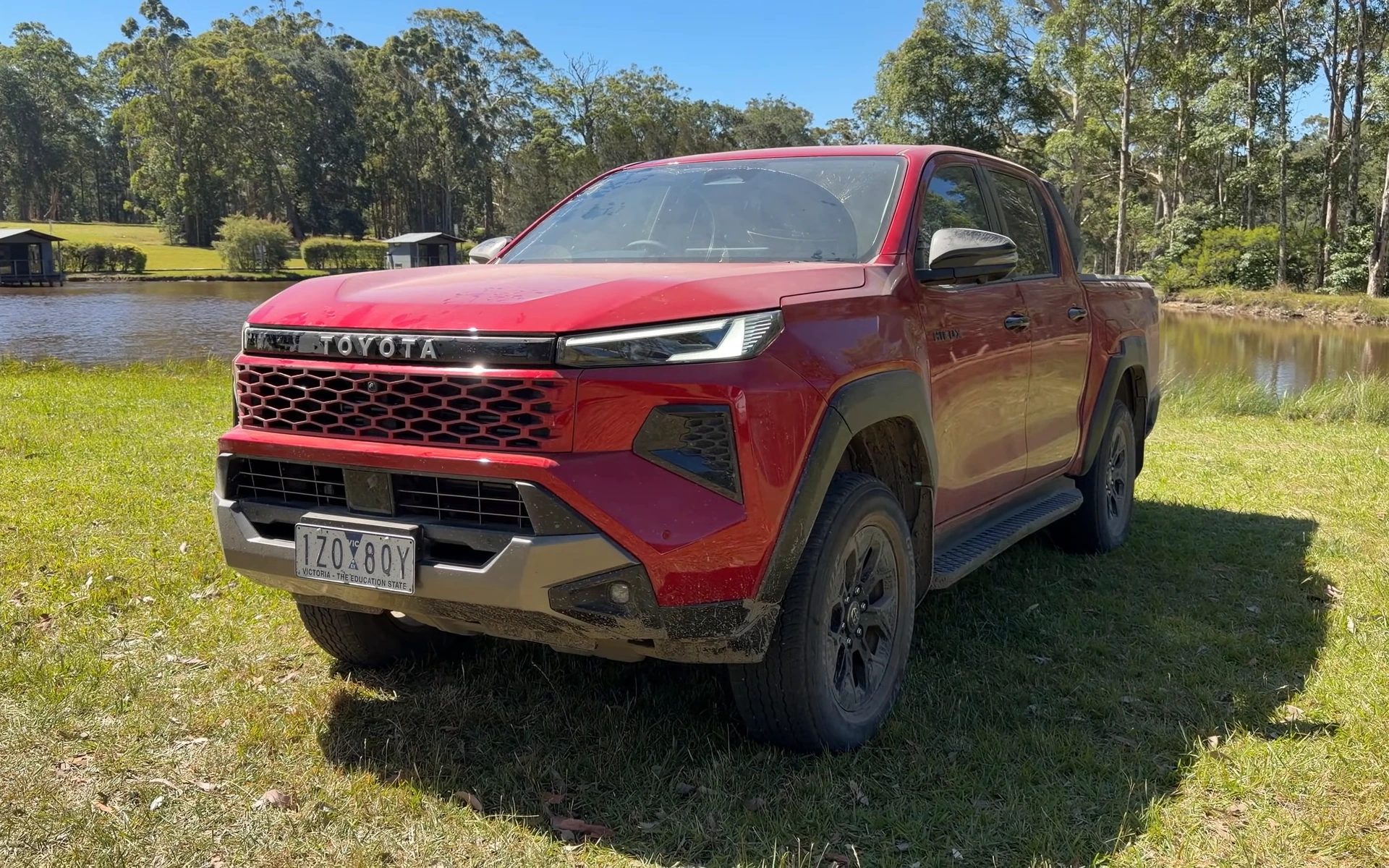
2027 Toyota HiLux Rogue Review
The 2027 Toyota HiLux Rogue brings a smarter cabin, lighter steering and a better ride. Are those changes enough to keep this proven ute on your shortlist?

The HiLux makes meaningful improvements where they matter most: steering, everyday comfort and cabin usability. The Rogue remains an easy, capable off-roader with a proven diesel engine, while its familiar rear-seat and tray limitations do little to undermine a convincing overall update.
Read why ↓$71,990
150 kW
500 Nm
9.6L/100km observed; approximately 7.1–7.6L/100km claimed across the range
5-Star Rating
2027
- Electric steering and revised suspension transform everyday usability
- Much-improved cabin with useful technology and physical controls
- Proven diesel and confident, accessible off-road capability
- Rear-seat space and under-seat storage remain limited
- Some hard plastics and no ventilated front seats
- Test fuel use and six-monthly servicing temper running-cost appeal
Intro
The 2027 Toyota HiLux looks like it wants an argument. That angular nose is a substantial departure from the familiar workhorse, even if the chassis underneath is rather less revolutionary.
Toyota calls this the ninth generation, but much of the underlying platform remains familiar. The more important question is whether the changes make it a better ute to drive, work in and live with. On that front, there is considerably more progress than the shared foundations suggest.
New electric power steering, revised suspension and a thoroughly refreshed dashboard tackle some longstanding HiLux complaints. The 2.8-litre turbo-diesel is now standard across the range, while the flagship Rogue adds the comfort equipment expected of a $71,990 lifestyle ute.
Our video review covered sealed roads and off-road courses across the range, with the Rogue as the main focus. It makes a stronger case than the familiar mechanical recipe might have you expecting.
How much does the Toyota HiLux cost?
Finance or novated lease this Toyota HiLux
Get a free, no-obligation quote from our finance partner, Loan Options — for straightforward car finance, or package this car through your salary with a novated lease.
The HiLux is no longer an especially cheap way into a work ute, but the higher entry price now buys the 2.8-litre turbo-diesel rather than a smaller engine. At the other end, the Rogue's $71,990 price brings a substantial equipment list, including a powered roller tonneau, leather-accented upholstery and factory towing hardware.
It is still premium money. The Ford Ranger XLT V6 costs $67,990 before on-roads and supplies a stronger engine, while the Mitsubishi Triton GLS is considerably cheaper at $60,140. An Isuzu D-Max LS-U+ sits around $68,000, giving buyers another established diesel alternative.
Within the HiLux range, the SR5 automatic pick-up at $65,990 deserves serious consideration. Its optional $2500 Premium Interior Pack adds leather-accented seats, JBL audio and an eight-way power-adjustable driver's seat, although the Rogue still bundles additional convenience and safety equipment.
Premium paint adds $675. All prices below exclude on-road costs.
2027 Toyota HiLux Pricing
- WorkMate 4x2 single cab-chassis manual $33,990
- WorkMate 4x2 single cab-chassis auto $35,990
- WorkMate 4x2 double cab pick-up auto $47,990
- SR 4x2 double cab pick-up auto $52,990
- WorkMate 4x4 single cab-chassis auto $45,990
- WorkMate 4x4 double cab-chassis auto $52,490
- WorkMate 4x4 double cab pick-up auto $53,990
- SR 4x4 extra cab-chassis auto $54,990
- SR 4x4 double cab-chassis manual $54,990
- SR 4x4 double cab-chassis 48V auto $57,990
- SR 4x4 double cab pick-up 48V auto $59,490
- SR5 4x4 double cab pick-up manual $63,990
- SR5 4x4 double cab-chassis 48V auto $64,490
- SR5 4x4 double cab pick-up 48V auto $65,990
- Rogue 4x4 double cab pick-up 48V auto $71,990
- Rugged X 4x4 double cab pick-up 48V auto $71,990
Got a car to sell or trade in?
Get competing offers from dealers with CarSauce Sell. Free, no obligation.
Get my offersThe nose makes no attempt to blend in
Toyota's ‘Cyber Sumo’ styling gives the HiLux a much more assertive face. Slim, high-mounted headlights, prominent Toyota lettering and a heavily patterned grille make the front end look taller and more angular than before.
The proportions work better in person than they do through a camera lens. Feverish Red also suits the Rogue particularly well, providing a strong contrast against the black exterior detailing without needing a forest of decorative accessories.
The design was developed by teams in Melbourne and Thailand, and there is a practical reason for positioning the headlights high: reducing their exposure to scrub on narrow tracks. LED headlights are standard across the range.
From the side, the familiar cabin shape gives away how much carries over. The Rogue adds matte-black 18-inch wheels, Dunlop Grandtrek all-terrain tyres, black handles and mirror caps, privacy glass and a sailplane-style sports bar.
There are useful changes at the back, too, particularly the new tub-access steps. The loss of the previous wider-track arrangement is disappointing, but we reckon the overall styling still gives the Rogue enough presence without pretending it is an entirely different vehicle underneath.
A proper cabin upgrade without hiding the buttons
The front cabin is where the update most convincingly earns its keep. A 12.3-inch touchscreen is standard, while the Rogue pairs it with a 12.3-inch digital instrument cluster and a much more contemporary dashboard layout. The cabin has not physically become wider, but the horizontal design makes it feel less confined.
The leather-wrapped steering wheel feels good in the hand, and the redesigned leather-accented seats offer a comfortable driving position. The driver's seat has power adjustment and lumbar support, with useful under-thigh support. Heated front seats and a heated steering wheel are welcome, although ventilated seats would be particularly useful in an Australian ute.
Physical dual-zone climate controls are a better everyday solution than burying temperature adjustment in a touchscreen. The conventional gear selector is straightforward, and the four-wheel-drive controls sit together within easy reach. This is a cabin that mostly prioritises getting things done over looking clever.
The touchscreen is large and bright, with wireless Apple CarPlay and Android Auto, but Toyota's native interface remains fairly basic. The digital cluster supplies useful vehicle and off-road information, while the Rogue's surround-view and trail cameras are more valuable additions than another page of graphics. Wireless charging, USB-C ports, JBL audio and a 300W household-style outlet round out the technology.
Storage is thoughtfully arranged, from the twin glovebox areas to dash-mounted cupholders and removable centre cupholders. The upper storage compartment receives air from the climate system, making it useful for keeping a drink or lunch cool. Hard, scratchy plastics remain across parts of the dashboard and doors, but softer armrests and better presentation make this a substantial step forward.
The back seat missed the growth spurt
The rear seat is the clearest reminder that the HiLux retains its familiar cabin structure. Headroom is generous enough, but legroom behind a taller driver is limited and there is little space to slide your feet beneath the front seat.
The high floor also leaves your knees raised, which is less relaxing over a long journey. The seat cushioning itself is agreeable, but it cannot disguise the underlying seating position. Against the roomier Ford Ranger, the HiLux remains the less convincing choice for regularly carrying adults in the back.
Amenities in the Rogue are respectable. Rear air vents, USB-C charging ports, map pockets and a folding centre armrest with cupholders cover the basics, while a large grab handle helps with climbing aboard.
The 48V battery compromises storage beneath the rear bench. There is a small accessible compartment, rather than the broad under-seat space you might hope to use for recovery gear or work equipment. For occasional passengers this is manageable, but families should spend time in the back before signing anything.
The tub gets easier to use, not bigger
The HiLux's tray dimensions are unchanged, so its basic cargo-carrying strengths and limitations carry over. A standard Australian pallet still will not fit, giving the Ford Ranger an advantage for buyers who regularly move palletised loads.
Access is better thanks to the rear-side steps, and the damped tailgate is easier to manage than a heavy, unsupported panel. A full-size spare is another sensible inclusion for a ute likely to venture well beyond suburban tyre shops.
The Rogue's electric roller tonneau adds convenience, while its marine-grade carpet liner makes the tray a little more accommodating for luggage and recreational gear. There are tie-down points for securing loads, although buyers carrying dirty or abrasive materials should consider whether a carpeted tub suits their work.
Four-wheel-drive variants can tow up to 3500kg braked, with a 750kg unbraked limit. The SR5 and Rogue have a 3120kg GVM, while 4x4 models have a 6300kg GCM; those figures need to be considered together rather than treating maximum towing and maximum vehicle loading as independent allowances.
The Rogue includes a factory tow bar and brake controller. Accessories, occupants, tow-ball load and tray cargo all consume available carrying capacity, so checking the actual loaded vehicle matters more than simply shopping by the headline towing number.
The steering is the change you feel first
Electric power steering makes the biggest immediate difference to the HiLux's everyday manners. Low-speed manoeuvres require considerably less effort, yet the steering retains reassuring weight on the highway. Parking and threading through tight spaces no longer feel like exercises that need to be tolerated for the sake of owning a ute.
The Rogue's multi-purpose suspension tune also shifts the balance towards everyday comfort. Revised suspension settings and a stiffer front stabiliser bar give it better body control through corners, with less of the unsettled behaviour associated with an unladen workhorse.
The powered tonneau assembly adds weight over the rear, which helps settle the Rogue's ride. It is notably more comfortable than the heavy-duty suspension in the lower-grade work-focused variants, so a test drive in one HiLux should not be taken as representative of the entire range.
On our road drive, the Rogue felt substantially easier to live with than the previous HiLux. It handled tighter roads with greater composure, while the new steering made the whole vehicle feel less cumbersome. The cabin's improved noise isolation also contributes to the more polished impression.
The Ford Ranger remains a strong reference point for ride and handling, and Toyota has not erased every consequence of its older architecture. Even so, this is meaningful progress rather than a cosmetic update dressed up as a dynamic transformation. The HiLux now makes a much more convincing case as a daily driver as well as a work vehicle.
Familiar hardware still makes light work of the climb
The HiLux retains a part-time four-wheel-drive system with high and low range, rather than offering a full-time setting for ordinary sealed-road use. Ground clearance is 224mm, with a 29-degree approach angle and a 25-degree departure angle; the Rugged X improves on the latter. These are familiar fundamentals, but they remain effective ones.
The SR 4x4 climbed the steep, uneven section of our test course without requiring its rear differential lock. Low range and the rock setting within Multi-Terrain Select provided enough control to work over roots and uneven surfaces without drama. The heavy-duty suspension was noticeably firmer, but capability was not in question.
Electric steering improves the experience here as well as on the road. Tight turns require less effort, and impacts do not produce the same steering-wheel kickback as the old hydraulic setup. That makes deliberate wheel placement easier when the track narrows.
The Rogue was more comfortable across the articulation section, and its trail camera was genuinely useful for judging wheel placement beside a bank. The system is included from SR5, along with the broader Multi-Terrain Monitor. It is an aid rather than a substitute for checking the terrain, particularly when side steps are close to obstacles.
The most irritating detail was the parking sensors sounding repeatedly off-road, with no readily obvious way to silence them during the drive. For buyers taking rougher routes regularly, the Rugged X adds a more substantial steel bash plate and front and rear recovery points. The Rogue nevertheless showed that its lifestyle equipment has not displaced the HiLux's core ability.
Five stars, with a Rugged X exception
The HiLux has a five-star ANCAP rating, covering all variants except the Rugged X. The Rogue tested here is included, with scores of 84 per cent for adult occupant protection, 89 per cent for child occupant protection and 82 per cent each for vulnerable road user protection and safety assist.
Toyota Safety Sense brings autonomous emergency braking, adaptive cruise control, road sign assistance and lane trace assistance to the range. The move to electric power steering enables more useful active steering assistance, rather than relying on warnings alone when the vehicle approaches a lane marking.
On the highway, that lane-centring capability makes the HiLux easier to manage over a long stint. It remains a driver-assistance system, not self-driving technology: the driver must stay attentive and in control.
A reversing camera and front and rear parking sensors form part of the base equipment list. SR5 adds the 360-degree Multi-Terrain Monitor and Emergency Driving Stop System, while the Rogue adds blind-spot monitoring and rear cross-traffic alert. Those last two features are particularly useful on a large dual-cab, and their inclusion strengthens the flagship's case.
One diesel does the lot
Toyota has simplified the engine range around its familiar 1GD 2.8-litre four-cylinder turbo-diesel. The smaller 2.4-litre diesel and 2.7-litre petrol are gone, as is the GR Sport variant. Every remaining model now starts with the same basic diesel hardware.
Output is 150kW, with 500Nm when paired with the six-speed automatic or 420Nm with the six-speed manual. The Rogue combines the automatic with Toyota's V-Active 48V mild-hybrid system. It remains fundamentally a diesel ute, not an alternative to a plug-in hybrid for electric commuting.
The engine's useful torque makes low-speed off-road work straightforward, and its established track record is a meaningful part of the HiLux's appeal. Familiarity is not a guarantee against future faults, but neither should proven hardware be dismissed simply because it is not new.
There is stronger competition if outright performance is the priority. The Ford Ranger XLT V6 delivers 184kW and 600Nm through a 10-speed automatic, whereas the Isuzu D-Max LS-U+ produces 140kW and 450Nm. The Mitsubishi Triton GLS matches the Toyota's power with 150kW, but has slightly less torque at 470Nm.
Observed fuel consumption during our test was 9.6L/100km, against claimed combined figures of approximately 7.1–7.6L/100km across the HiLux range. That mixed first-drive result is not a controlled economy comparison, but it does show that the mild-hybrid badge should not be mistaken for a promise of dramatically lower diesel bills.
The service calendar still fills quickly
Finance or novated lease this Toyota HiLux
Get a free, no-obligation quote from our finance partner, Loan Options — for straightforward car finance, or package this car through your salary with a novated lease.
Toyota covers the HiLux with a five-year, unlimited-kilometre warranty. Engine and driveline coverage can be extended through qualifying Toyota logbook servicing, so the conditions are worth checking against the way the vehicle will be maintained.
Servicing is required every six months or 10,000km. That means two scheduled visits a year even for an owner who travels relatively modest distances, which is a less convenient arrangement than the annual service schedule many buyers would prefer.
The 9.6L/100km observed during testing also deserves a place in the ownership calculation. The 48V system does not remove the running costs associated with a substantial diesel ute, especially when accessories, cargo or a trailer enter the picture.
The established 2.8-litre engine is a major reason to consider the HiLux, but a reputation for durability should not be confused with maintenance-free ownership. We would buy it for the familiar hardware and improved usability, rather than assume the Toyota badge automatically delivers the lowest whole-of-life bill.
What do you get with the Toyota HiLux
WorkMate
- 2.8-litre turbo-diesel engine
- 17-inch steel wheels
- LED headlights
- 12.3-inch touchscreen with wireless Apple CarPlay and Android Auto
- 7-inch digital instrument cluster
- Reversing camera and front and rear parking sensors
- Toyota Safety Sense with AEB, adaptive cruise control, lane trace assist and road sign assist
SR
- 17-inch alloy wheels and LED fog lights
- Smart entry and push-button start
- Wireless phone charging
- Eight-speaker audio system
- 300W inverter
- Side steps
- Rear differential lock, Multi-Terrain Select and downhill assist on 4x4 models
- 48V mild-hybrid system on specified automatic variants
SR5
- 18-inch alloy wheels
- Dual-zone climate control
- Heated front seats and steering wheel
- 12.3-inch digital instrument cluster
- Auto-dimming rear-view mirror
- 360-degree Multi-Terrain Monitor with trail and underbody views
- Emergency Driving Stop System
- Rear air vents
- Optional $2500 Premium Interior Pack with leather-accented seats, JBL audio and an eight-way power-adjustable driver's seat
Rogue
- SR5 Premium Interior Pack equipment as standard
- 48V automatic powertrain
- Matte-black 18-inch alloy wheels
- Electric roller tonneau
- Marine-grade carpet tub liner
- Sailplane-style sports bar and unique bumper
- Factory tow bar and brake controller
- Blind-spot monitoring and rear cross-traffic alert
Rugged X
- Joint flagship pricing with Rogue, with an off-road-focused equipment package
- 48V automatic powertrain
- More substantial steel bash plate
- Front and rear recovery points
- Tow wiring harness
- Improved departure angle
Final thoughts on the 2027 Toyota HiLux
The 2027 Toyota HiLux does not need an entirely new platform to become a substantially better ute. Electric steering, the Rogue's revised suspension and a more welcoming cabin address issues that owners encounter every day, not just things that look impressive in a showroom.
The rear seat remains tight, the tray still cannot take an Australian pallet and the cabin retains some hard plastics. Buyers wanting the most spacious family ute or the strongest diesel performance should still drive a Ford Ranger, while the Mitsubishi Triton and Isuzu D-Max make credible value-led alternatives.
For the HiLux buyer who values established hardware but wants less compromise on the daily commute, the Rogue is a particularly convincing answer. Its easy off-road progress, useful towing specification and comprehensive convenience equipment complement the improvements rather than distract from them.
We would shortlist the Rogue without hesitation, while also looking closely at an SR5 automatic with the Premium Interior Pack if the powered tonneau and extra flagship equipment are not priorities. The A grade reflects a well-judged update that makes the HiLux better where it needed to be, while preserving the capability that made it worth considering in the first place.