
BYD Shark 6 Premium vs Performance: What Does the Extra $5000 Buy?
Compare BYD Shark 6 Premium and Performance prices, power, towing, payload, range and equipment to understand what the $5000 upgrade adds.
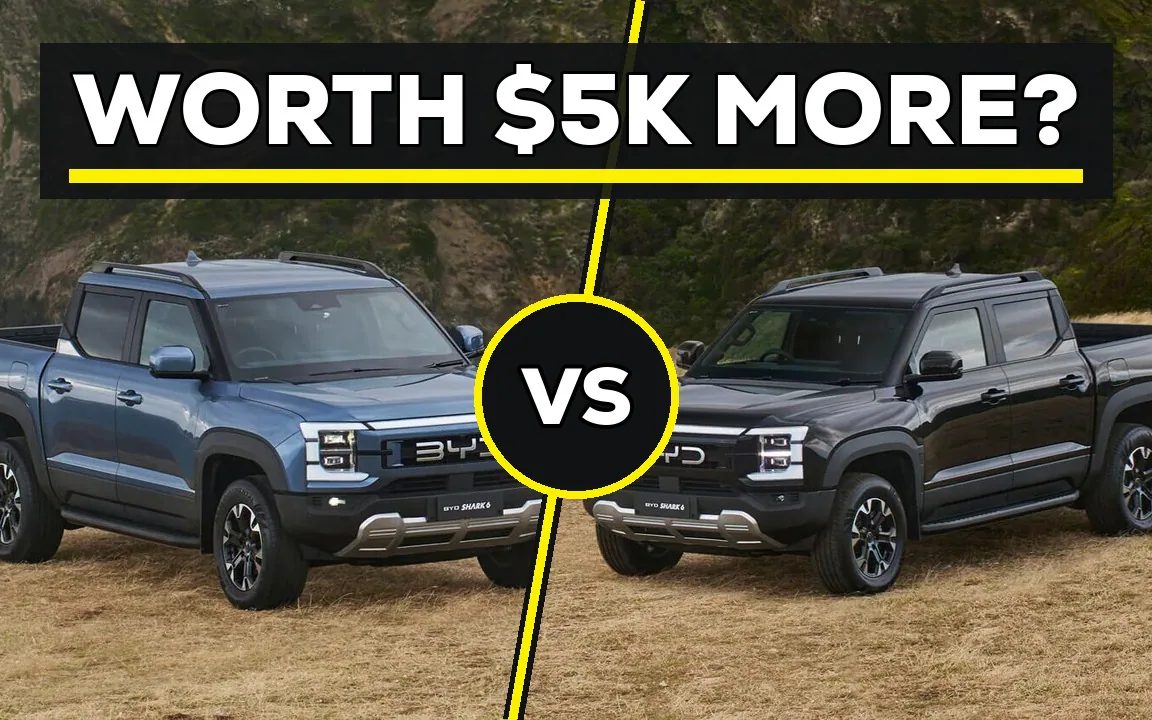

The BYD Shark 6 Performance costs $5000 more than the Premium in Australia, with the main differences being a larger petrol engine, higher combined outputs and a 1000kg increase in braked towing capacity.
Much of the cabin equipment is shared, while the Performance has a lower payload despite its higher towing rating.
Car finance or novated leasing could save you thousands
Get a free, no-obligation quote from our finance partner, Loan Options — for straightforward car finance, or package this car through your salary with a novated lease.
The 2027 BYD Shark 6 Premium costs $57,900 before on-road costs, compared with $62,900 before on-road costs for the 2027 BYD Shark 6 Performance. The Premium produces 321kW and 650Nm and claims 100km of electric range on the NEDC cycle, while the Performance delivers 350kW and 700Nm and claims 80km on WLTP. Those different range-testing methods mean the figures are not directly comparable.
| Specification | Premium | Performance |
|---|---|---|
| List price before on-road costs | $57,900 | $62,900 |
| Petrol engine | 1.5-litre turbo | 2.0-litre turbo |
| Combined power / torque | 321kW / 650Nm | 350kW / 700Nm |
| Claimed 0-100km/h | 5.7 seconds | 5.5 seconds |
| Battery capacity | 29.58kWh | 29.58kWh |
| Braked towing capacity | 2500kg | 3500kg |
| Payload | About 790kg | 762kg |
| Claimed electric range | 100km NEDC | 80km WLTP |
| Claimed combined range | 800km NEDC | 640km WLTP |
| Claimed fuel consumption | 2.0L/100km ADR 81/02 | 1.3L/100km combined WLTP |
| Charge-sustaining fuel consumption | — | 10.5L/100km WLTP |
| Touchscreen | 15.6-inch rotating | 15.6-inch with Google built-in |
| Crawl Mode | Over-the-air update announced | Standard |
Prices and offers are current as at 16 November 2026. BYD's $4000 cashback offer, including GST, covers both grades for eligible retail orders placed between 1 October and 21 December 2026 and delivered by 31 December 2026.
Alternatively, buyers can access 0.99 per cent finance, but it cannot be combined with the cashback. Fleet vehicles and demonstrators are excluded, and the equal cashback amounts leave the $5000 gap between grades unchanged.
Both versions use front and rear electric motors for all-wheel drive, paired with a 29.58kWh LFP Blade Battery. The petrol engine mostly acts as a generator, although it can drive the front wheels directly at higher road speeds.
The Performance's 2.0-litre engine increases combined output by 29kW and 50Nm over the Premium's 1.5-litre system. Its claimed 0-100km/h time falls by 0.2 seconds, from 5.7 to 5.5 seconds.
The larger engine can also generate up to 90kW, compared with 70kW from the 1.5-litre unit, helping support sustained loads such as towing.
Braked towing capacity rises from 2500kg to 3500kg, but payload falls from about 790kg to 762kg because the Performance is heavier. The higher towing rating therefore does not bring a corresponding increase in carrying capacity.
In CarSauce's Shark 6 Performance review, the ute remained composed while towing a 2.8-tonne caravan, including under braking and during an evasive manoeuvre. Crawl Mode also noticeably improved grip on muddy climbs.
Neither grade has a low-range transfer case or mechanical differential locks, and both use independent double-wishbone suspension front and rear. Crawl Mode is a low-speed traction and throttle-control function rather than a replacement for that mechanical hardware.
The economy figures require the same caution as the range claims: the Premium's 2.0L/100km figure uses ADR 81/02, while the Performance's 1.3L/100km combined figure uses WLTP. They do not establish a like-for-like efficiency advantage for either grade.
The Performance also has a quoted WLTP charge-sustaining figure of 10.5L/100km. BYD said it achieved 18L/100km while testing the Performance with a 3.5-tonne caravan in Queensland.
Inside, both grades have a 15.6-inch touchscreen, 10.25-inch digital instruments, wireless Apple CarPlay and Android Auto, a head-up display and heated, ventilated, power-adjustable front seats.
An 11-speaker Dynaudio audio system, 50W wireless charger and 360-degree camera are also shared. Both provide 6.6kW vehicle-to-load capability, with 230V outlets in the cabin and three in the tub.
The Premium's touchscreen rotates, while the Performance's screen includes Google built-in, bringing native apps including Google Maps with live traffic. The Performance also has Continental CrossContact tyres and standard Crawl Mode, which BYD said existing Shark 6 models would receive through an over-the-air update.
Both grades have 18-inch alloy wheels, a spray-in tub liner and a powered tailgate, with little visual distinction between them. CarSauce's review found the Performance's new column shifter and stalks felt less substantial.
Ownership coverage is shared: the range has a five-star ANCAP rating from 2025, a six-year/150,000km vehicle warranty and an eight-year/160,000km battery warranty. BYD's published servicing totals $2489 over five years or 100,000km.
Which grade matches the intended use?
For buyers whose braked towing requirements remain within 2500kg, the Premium meets that towing threshold at a $5000 lower list price and provides about 28kg more payload. It also retains most of the Performance's cabin equipment.
For a caravan or boat weighing more than 2500kg and up to 3500kg, only the Performance has the required braked towing rating of these two grades. Its additional engine-generation capacity, standard Crawl Mode and Google built-in are the other principal differences.
The choice therefore centres on towing requirements, payload and those equipment changes rather than a substantially different cabin or appearance. The Premium has the higher published electric-range number, but the different test cycles prevent treating that as proof it travels further on a charge.
Got a car to sell or trade in?
Get competing offers from dealers with CarSauce Sell. Free, no obligation.
Get my offersFrequently Asked Questions
The Performance is $62,900 before on-road costs, which is $5000 above the $57,900 Premium. Eligible buyers can receive the same $4000 cashback on either grade under BYD's offer ending in December 2026, so the price gap remains unchanged.
No. Its braked towing capacity rises to 3500kg from the Premium's 2500kg, but payload falls to 762kg from about 790kg.
Its published claim is higher at 100km, versus 80km for the Performance, but the Premium uses NEDC testing and the Performance uses WLTP. Those figures cannot establish a direct range advantage.
Neither has a low-range transfer case or mechanical differential locks. Both use electric-motor all-wheel drive, while the Performance's standard Crawl Mode manages traction and throttle response at low speeds.
Related Articles

2027 BYD Ti9 Is a Boxy 5.27-Metre PHEV Giant That Charges in Nine Minutes
1 week ago

Researchers Uncover Number Plate Route to Unlocking Connected Cars in Australia
1 week ago
2027 Denza N8 Launches in China With 1003km Claimed EV Range
1 week ago
Chery Stockman vs BYD Shark 6 vs GWM Cannon vs Cannon Alpha vs JAC Hunter: PHEV Ute Prices and Specs Compared
1 week ago